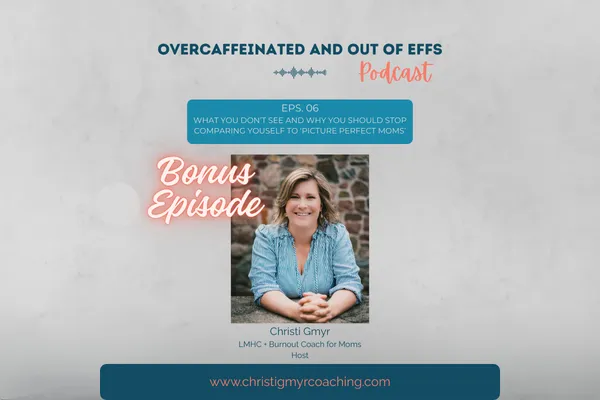
EPS. 06 What You Don't See and Why You Should Stop Comparing Yourself to 'Picture Perfect Moms' - Transcript
Episode 06: What You Don't See and Why You Should Stop Comparing Yourself to 'Picture Perfect Moms' - Transcript
[00:04] Christi Gmyr: Welcome to Overcaffeinated and Out of Effs, the podcast for burned out, career-minded moms who are ready to stop pretending everything's fine and feel like themselves again.
[00:15] I'm your host, Christi Gmyr, burnout coach for moms, licensed therapist and mom of two. And I'm here to help you reclaim your energy, your identity, and your peace of mind.
[00:25] Whether you're lying awake thinking about the 87 things you didn't get done or silently resenting the people you love most,
[00:32] This is your space to feel seen, supported, and not so alone.
[00:36] So grab your coffee, hot, cold or day old, and let's get into it.
[00:47] Hey, everybody, it's Christi.
[00:49] Welcome to Over Caffeinated and out of Effs.
[00:53] So today's episode,
[00:56] this was not part of my plans for today.
[00:58] I really didn't prepare for this very much. You know, honestly, what happened is this morning I was at a hair appointment. I was getting my hair cut and highlighted, and I was thinking about this podcast.
[01:11] It's something that I think a lot about these days.
[01:14] As I'm sure a lot of, you know, this is a pretty new podcast. I just really released it maybe a month or so ago. And so as I'm sure you can also probably imagine, just this whole thing, podcasting in general is a new thing for me.
[01:30] And so because of that, I have been spending a lot of time trying to learn about it. Right? I've been listening to other podcasters,
[01:36] specifically people who teach about podcasting, because I want to learn.
[01:41] You know, I have this vision. I started it because I have this vision,
[01:45] this goal of helping and supporting all of you working moms.
[01:49] And I definitely have a lot to say, and I think it can bring a lot to the table.
[01:53] But again, podcasting specifically, it's just. It's a brand new platform for me. And so there's just like anything, there's a lot to learn. So anyway,
[02:01] point being, I was sitting in the waiting area at my hair appointment this morning with, you know, my foils on my head, waiting for the color to set in. And I was listening to this other podcast and she was talking about how,
[02:14] you know, she had gotten started.
[02:16] And as I was listening to her talk,
[02:19] I was thinking about,
[02:20] you know, some of my own experiences.
[02:24] And I w. I started thinking about this one challenge that I've been having in particular that I know so many of you moms out there can relate to.
[02:33] And it's something that I have been struggling to figure out, how to put it into words or even if I should put it into words, you know, and it has to do with comparing ourselves to others, especially on social media,
[02:48] how it's such a big problem for so many of us.
[02:52] But ultimately I decided that it is something that I want to talk about. And so, you know, as the girl was cutting my hair, and then the whole drive home, I was literally just thinking about getting home, getting to my computer as fast as I could before these thoughts leave my head.
[03:06] And then on top of that, I was thinking,
[03:09] you know, I don't want to wait until,
[03:12] well, you know, my. My new episode release on Tuesday.
[03:15] So not even next Tuesday because I already have my next episode all lined up. So really the Tuesday after that, I just didn't want to wait that long to. To say all of this.
[03:23] And so I decided to come home,
[03:27] record these thoughts, and as a result, you were all getting this bonus episode today.
[03:34] So instead of doing,
[03:36] you know, all these other thousand things that I had planned from my to do list today, I am doing this instead. It just feels, you know, more important right now.
[03:44] So whatever, I will get to those other things later.
[03:48] So the thing that I wanted to talk about has to do with, as I mentioned a minute ago, our tendency to compare ourselves to others,
[03:56] especially with the things that we see on social media and how that affects us.
[04:03] So just to give you a little bit of a background so then I can talk to you about how this has been affecting me personally.
[04:09] You know, you've all heard me talk about my background in mental health and that I've worked as a therapist for.
[04:15] I don't even know Exactly. Probably like 16, 17, maybe even 18 years, something like that.
[04:20] And then I transitioned into the role of burnout coach.
[04:25] So something that most people don't really know unless you are in this field, is that therapy and coaching, although they're related,
[04:34] they're actually very different in a lot of ways.
[04:38] And one of the big things that makes them different, one of the big things that's different about them is how they attract clients, how they get in front of the right people,
[04:49] the people who are, you know, really looking for them so that they can get the help that they are, the help and support that they. That they want, that they need.
[04:58] So with therapy in particular, which, again, that's where my background really is for all these years, primarily,
[05:04] you know, it's. It's pretty straightforward for the most part. You know, I have a website that I invested a lot of time and money into, my SEO.
[05:11] For a while. I had a profile on Psychology Today, maybe Some of you have heard of that.
[05:16] I eventually took that down for reasons that I'm not going to get into right now. But it was something that I had for a while. You know, I network with other therapists.
[05:25] I do things like that because generally speaking, when people are looking for therapists,
[05:30] they do just that. They go out and they look for them. They might do a Google search, they might read up on profiles, they might ask for recommendations from their community.
[05:38] They might contact a therapist who, for whatever reason, can't work with them.
[05:43] You know, maybe they don't have availability, or maybe they're not a good fit because of the areas that they specialize in,
[05:49] whatever other reason. And so they'll then usually make other recommendations or referrals.
[05:55] So. And then once these people, these potential clients, you know, have an idea of who they might like to work with,
[06:02] they reach out to them. Right?
[06:04] So that's how it usually works with therapy. Coaching, on the other hand,
[06:09] is very different in that people aren't usually looking for them in the same way that they might look for a therapist.
[06:16] Coaching involves a lot of marketing and sales.
[06:21] Now, most therapists,
[06:22] and I would venture to say most people, when they first get into coaching,
[06:27] probably have very little if any experience in marketing and sales, myself included.
[06:33] I'm a therapist. I am a coach.
[06:36] I have a lot of experience, both personally and professionally, that I know can be so valuable to other moms.
[06:42] But I really don't have experience in marketing and sales. And why would I? It's just, that is not what I do. That's not what I went to school for. That's not what my work has been in.
[06:52] And so I've been learning.
[06:55] And I promise my story has a point.
[06:58] So, you know, I'm constantly researching things, things online. You know, I've hired and worked with a coach myself to help me with these things.
[07:05] And because of all that, the algorithm has started pushing these things at me. And I'm sure you all know how that goes. You look up for. You look up a few things, and suddenly your feed is flooded with a specific type of content.
[07:18] So I'm constantly, you know, as a result, I'm constantly being bombarded with all these ads for business coaches and whatnot, you know, trying to sell me their services.
[07:27] You know, I'm also getting ads from, you know, other,
[07:30] you know, burnout coaches, other people who do similar things to what I'm doing. You know, these are the things that are flooding my feed.
[07:39] So anyways, when I. When I see these ads,
[07:43] I don't just scroll past them.
[07:45] Not because I'm necess, not because I'm looking to buy from them necessarily, but because I'm trying to learn from them. And because I have taken some courses in basic marketing.
[07:53] Now I can see the strategy, the psychology, I can see the intention in these posts. I'm looking at them through a different lens than maybe I would have before.
[08:03] And I gotta tell you, and now here's where I'm sort of getting to my point is that sometimes, maybe a lot of times,
[08:11] I get kind of mad. I get kind of mad when I see these posts. I get kind of mad when I see these advertisements.
[08:19] And the reason for that is because,
[08:21] you know,
[08:22] these ads, what they're trying to do is show you a picture of the life they want to sell you.
[08:29] You know, the ads that I see talk about,
[08:32] for example, you know, the freedom in life that coaching can give you or the freedom that you can have if you have a full practice of private pay therapy clients, you know, whatever it is,
[08:46] they really hone in on balance because they know that that's something that so many people struggle with, which of course they do. Right? That's why we're all here.
[08:54] The problem that I have is that they try to sell their programs by showing pictures of themselves at the spa,
[09:03] showing pictures of themselves on vacation,
[09:05] showing pictures of themselves at the gyms.
[09:08] You get the idea.
[09:10] They basically paint this picture of the cross quote, unquote perfect life that you can supposedly have if you just do these things. If you just sign up for their program,
[09:20] you know,
[09:22] buy the thing that they are trying to sell you.
[09:24] And the reason
that I get frustrated or mad is because they paint a picture of a life that really is not realistic for most people. I hate to say it, but that's, that's the reality.
[09:36] You know, learning how to manage your home and a work life is an important thing to do and we can absolutely do it. I just don't agree with how they do it.
[09:46] You know, most people are not going to get their nails done or get a massage a month after having a baby.
[09:54] Most people are not spontaneously jumping on airplanes to Florida for the weekend. They're just not the picture of balance that is often painted in these ads. This picture of balance that they're trying to sell and what balance realistically looks like for most people are not the same.
[10:13] And so when I see those ads,
[10:16] I'll be honest, you know, they make me feel a mix of excitement as I'd fantasize my own life looking like that. Which is, of course, what they're trying to do.
[10:25] That's the psychology behind it.
[10:28] And then I. And so I have this mixture of excitement and then also feeling kind of of like **** for not actually having that life.
[10:35] Which is what unfortunately happens when we compare our own lives to what we often see online.
[10:43] You know, when I see these ads, I get mad because I think,
[10:47] you know, for me personally, this is exactly what I tell moms not to do when I'm working with them. I talk to them about not comparing themselves.
[10:55] You know, obviously I don't just say, don't, don't do it. Cause it's easier said than done. But the point is, that's something that I work with them on and that's something that I talk to them about.
[11:02] You know, do not compare yourself to what you see people doing online.
[11:06] And I think that's a big part of the reason that, you know, honestly, I haven't really been doing that kind of marketing, you know, is because when I sit down to think about how I can make my own ads or posts or whatever,
[11:18] I think about those skills and strategies that they've been teaching me that I've been learning about.
[11:26] And the idea of actually doing them makes me feel like a total hypocrite.
[11:30] I just have not been doing it. You know, I don't love the idea of the exact thing I try to teach my clients about not doing as a way of actually, like,
[11:41] selling the program to them. It just. It seems backwards to me. And I'm not trying to,
[11:46] you know,
[11:47] talk badly about people and marketing or anything like that. That's not what I'm trying to do. All I'm trying to do is talk about how,
[11:54] you know, this idea of, like,
[11:57] what we see online,
[11:58] you know, how it can really sort of make us feel bad.
[12:03] And in this case, you know, I'm talking about, you know, the ads that I'm seeing related to coaching. Right.
[12:08] Because that is not why I personally started coaching. I started coaching because I really want to support working moms, but I don't. I don't want to sell them anything.
[12:18] Just like I don't want to sell my. My therapy services.
[12:22] I really, really don't.
[12:24] I can't tell you, like, how many times I've been on the phone with potential therapy clients. And, you know, we'll be talking about why they're reaching out, what they want support with.
[12:32] And I tell them, you know, a lot of times I'll tell them there's somebody else out there who's a Better fit for whatever reason. And then I give them names to other therapists.
[12:41] And a lot of times,
[12:42] you know, I've had. They've thanked me for doing that.
[12:45] Because the reason that I do that is because I'm really not trying to just get as many clients as possible by whatever means possible.
[12:53] I'm trying to get the right clients.
[12:55] And I'm being completely sincere and genuine when I say that I don't want people to hire me who don't really want my services.
[13:03] I just don't. That doesn't feel good to me. I want to work with people who truly want the help and support that I know I can provide,
[13:10] and I don't want to sell them on anything.
[13:13] And if after a conversation, it turns out that I'm not offering what they're looking for, that's okay, you know, it really is, because, again, I'm not a salesperson, right? That is not what my background is in.
[13:26] That's not what I ever sought out to do.
[13:29] I. I'm a therapist and I'm a coach.
[13:32] And again, that's a big part of the reason that I started this podcast. It's because,
[13:37] you know, as I continue on this journey, I'm also trying to learn and grow. And I'm constantly looking for ways to.
[13:45] To support moms. And I want to do it in a ways that feel aligned with my own values.
[13:52] And podcasting. Podcasting seems like a great way to do it. You know, people can choose. You know, they can. They can choose to listen if it's helpful for them. They can choose not to listen if it's not.
[14:03] It's a way to support the moms who really want it without really forcing it on them.
[14:09] And it's. It's really just about providing support,
[14:14] hopefully giving some helpful information and strategies and building community.
[14:21] And so I realize that this in and of itself might sound like a sales pitch, and I apologize. That's really, really not what I'm trying to do.
[14:28] Again, the whole thing about this is that it's just. It's something that I've personally been struggling with a lot. And I just think it's a really good example of how I'm personally being affected by the things I see on social media.
[14:42] When I start comparing myself,
[14:44] right, this idea of, like, oh, well, maybe if I do this, that, and the other thing, maybe I could have all of that, right? Like, even though I know what they're doing and I know the strategies behind it,
[14:55] doesn't mean I'm not affected by it, right?
[14:58] And I know that this is something that so many of us do. It's this comparison,
[15:03] even though we try not to.
[15:07] And I would be willing to bet that most of us are guilty of being on the other side of it, too.
[15:12] You know, intentionally posting things that present the image we want people to see.
[15:20] You know, I would encourage you guys to think about, like, how many of you listening, for example, have had family pictures taken by a professional photographer. Right. We'll just use this as an example.
[15:30] You know, once you're done, you've got these amazing pictures of your family to share with the world. But let's be honest.
[15:38] Did the photo shoot itself really go that perfectly?
[15:42] I kind of doubt it. You know, at least probably in most cases, maybe every once in a while. Maybe not a hundred percent of the time, but most of the time, I would imagine.
[15:53] My guess is, is that for most of you,
[15:56] there was a lot of stress that went into getting those pictures.
[16:00] Maybe there were toddler meltdowns at home, but getting in the car,
[16:04] Maybe there were arguments with your teen about what you want them to wear.
[16:08] Maybe your baby had a diaper explosion in the middle of the pictures.
[16:12] Maybe you were chasing kids around and trying to get them to sit perfectly still in the exact position that the photographer told you to.
[16:19] Maybe you took a thousand pictures.
[16:23] Just get one that looked the way that you wanted it to look. And when all is said and done,
[16:29] are you posting all of those pictures?
[16:32] No, you're just posting that one. You're just posting the one that has the final image that you want,
[16:38] and it's okay. Again, we all.
[16:41] Everybody, maybe not everybody's had professional pictures done, but everybody has some experience of this where,
[16:50] you know, you are putting on an image the way that you want to be seen,
[16:55] even if it doesn't necessarily include all of the information.
[17:01] Maybe you went on a vacation and posted all these pictures on social media with all the seemingly fun things you did. You know, I'll use Disney World as an example.
[17:10] Maybe you had a really great time overall. But my guess is that in between a lot of those really great moments,
[17:18] there were probably, again, a lot of really stressful moments.
[17:21] I mean, how. Like, how could there not be? Especially if you're going with young kids who are tired.
[17:26] Maybe they're missing their nap. Maybe their legs are hurting from walking. Maybe it's a hundred degrees out. Maybe their legs are.
[17:34] You know, maybe they're. They're just like, super tired or whatever. I know I already said that, but maybe they are.
[17:41] Maybe they're Getting impatient, like sitting in the line too, right? There just be so many things and maybe you're feeling super stressed out about how much money the vacation costs, right?
[17:54] But again, I'm guessing you're not showing that in most of your pictures or any of your pictures. Or at least maybe most of you are not. Maybe some of you are.
[18:03] My point is, is that appearances can be deceiving,
[18:08] especially on social media.
[18:11] They almost never show the full picture.
[18:14] They show what we want them to show.
[18:16] And let's be honest, even though we might be really happy for our friends and family who are, you know,
[18:22] doing all of these supposedly awesome things,
[18:27] a lot of times along with that, they make us feel like **** because we can't help but think about how we're not doing those things. And it doesn't have to be one or the other.
[18:36] And it doesn't make you like a bad person or a bad friend or whatever or anything like that. You can be happy for your friends and feel like bad or somehow be thinking, you know, negatively about your, your own life.
[18:51] Like both of those things can be true at the same time.
[18:55]
Does not have to be one or the other.
[18:59] A lot of posts,
[19:01] so a lot of posts unfortunately create a false state standard of what motherhood should look like too. So I was just talking in general about,
[19:09] you know, just how we're affected in general by, you know, what we see on social media in terms of our lives. And that's true in all different areas of our lives, but it's also,
[19:17] it's also true for motherhood. Right? And so when we compare ourselves to other moms, and again, it's true when we compare ourselves to anybody, but right now I'm talking specifically about moms.
[19:30] Well, really,
[19:31] you know, it can just,
[19:33] it can be a really big problem because it causes us to focus on what we think they are doing better than us.
[19:43] And then of course we then highlight,
[19:46] you know, our own inadequacy, right. Instead of focusing on or not even our own inadequacy. Let me rephrase that.
[19:52] Our own beliefs or our own perceptions of inadequacy doesn't actually mean that we're doing anything inadequately. But sometimes it can make us start to sort of question that or think about that instead of focusing on our own strengths and what we're doing.
[20:08] Well,
[20:10] and so it just,
[20:12] this can bring up feelings of self doubt and make us think that maybe we're just not doing a good enough job.
[20:21] If this is something that you are personally struggling with, you know, just quick Little thing to maybe consider,
[20:28] you know, it might be a good idea to maybe consider taking a break from social media or putting limits around your use.
[20:35] If that's not something that you want to do, at least try to pay attention to how you're feeling when you're done visiting certain sites or pages. You know, social media is not all bad, and that's certainly not what I'm trying to say.
[20:45] I do think that it can be really helpful in some ways,
[20:50] but I'm sure most of us can agree. Social media also comes with its problems. You know,
[20:55] and some of, like,
[20:58] sometimes social media can really leave us feeling pretty badly.
[21:03] Other times, you know, certain pages and whatnot might make us feel supported. You know, there, there's a little bit of both. But the point is, is that it's important to really pay attention to that.
[21:12] If you are paying attention and you realize, hey, every time I visit this page or every time I get on this particular social media platform or if it's making me feel badly, then maybe consider unfollowing accounts or unfollowing whatever that you notice are having that negative effect on you.
[21:33] And it's just, it's so important to remember,
[21:36] just in general that there are not there.
[21:42] We're never getting the full picture. There are always things that we're not seeing.
[21:46] And this is true on social media. It's also true just in life in general.
[21:50] You know, take, take a mom who seems to have it all together.
[21:55] How is she doing that really?
[21:57] You know, maybe she has a super flexible job.
[22:01] Maybe she has a partner who makes a lot of money and so she can afford to hire extra help.
[22:06] Maybe she has an amazing village of people to, you know, step up and support her.
[22:11] You know, maybe all of these different things are going into it to have to helping her at least put on this appearance like she has it all together. Or maybe in a lot of ways she, she does have it all together, but she's got these other things helping her.
[22:24] Very rarely are we just sort of like doing these things,
[22:27] doing everything,
[22:28] all the things,
[22:31] without at least struggling some. Right. Like there are challenges that come with that. It's never that easy.
[22:38] And all of us, every single person,
[22:41] you know, has things that are available to us to help us be successful in our own lives.
[22:47] Right?
[22:48] And if you have these things, you have, if you have access to these things, I'm not talking badly about any of that too. I think if you have the opportunity to hire out help or hire out support or lean on a support system or whatever, it might be you should absolutely take advantage of those things,
[23:02] you should absolutely lean on those supports.
[23:05] But everybody's situation is going to be different. The things that I have available to me might not be the same thing that my friend has available to her. And so we just really kind of have to use the things that we can.
[23:18] I have had conversations with people before in my personal life who I can tell are sometimes comparing themselves to my situation because,
[23:29] you know,
[23:30] just by comments that they've made, questions that they've asked, things like that, you know, because as a self employed therapist and coach,
[23:37] you know, maybe they see my life as having a lot of flexibility.
[23:41] And again, I can just sort of tell that by maybe the way that they're talking.
[23:46] And I, I get, I get the impression that maybe that is a particular thing that they envy is, is flexibility. Right. And that's maybe the thing that they're being focused on.
[23:56] And the truth is I do have a lot of flexibility,
[24:01] but there's more to the picture than that. Like there's more to my situation than having a flexible job. And it certainly didn't just happen that way.
[24:09] And there's always, always, always a trade off, you know, so I'm in a situation where I have a lot of flexibility because my husband and, and I made a lot of really difficult decisions to get here.
[24:21] Biggest one being that I left my job at the mental health agency I used to work at and now I have flexibility. Yes.
[24:27] But it, it comes at a cost. There's a trade off. In my situation,
[24:33] being self employed means I have no salary.
[24:36] I don't get sick days or vacation days or anything like that.
[24:42] Can I take sick days and vacation days when I want to and need to? Yes.
[24:47] Can I take time out of my day to go to my kids school event?
[24:51] Yes.
[24:52] But anytime I do that, I'm also not getting paid.
[24:56] Right. That's very different than having the security of a salary where maybe it's not as flexible but, but maybe you have that security.
[25:05] Right.
[25:06] Also,
[25:07] you know, a big part of the reason that we made these decisions is so, you know, so that I could have a more flexible job is because based on our personal circumstances, it was something that felt really important to us.
[25:19] It was something that we felt like we really, really needed,
[25:22] you know, because we unfortunately don't have a large village locally to help us with things.
[25:28] You know, if something comes up with our kids that needs our attention,
[25:31] 99.9% of the time it falls on us to manage. We don't have,
[25:35] you know, Friends or family who can easily come help out like so many other people do. I mean, yes, we have great friends, but they're busy. They've got their own lives.
[25:43] You know, we've got family, but most of them do not live locally.
[25:48] Right. And they, they're also busy. They also have things going on. Right. And so 99.9% of the time, the reality is, is that we just,
[25:57] we have to manage these things on our own.
[25:59] And so that flexibility is just something that felt especially important to us as we're prioritizing all these different things.
[26:07] And again,
[26:08] maybe that flexibility is something that people see as like this amazing thing.
[26:14] But that doesn't always mean that the whole picture, that there aren't other things happening behind the scenes that are, you know, that are part of that picture. And it doesn't always mean that things are as, as amazing as they look to the outside observer.
[26:28] And this doesn't mean not me complaining. Also, I want to mention this is just our situation, and I'm talking about it because I just want to share an example, share this example to demonstrate that things are not always the way that they appear.
[26:44] There are always other factors that affect people's lives that we might not be aware of, and it's important to remember that. So when you see somebody has something and you start comparing yourself,
[26:54] well, remember for starters, that there might be things that you're not aware of.
[27:00] But also everybody's circumstances are different.
[27:03] You know, what works for them and what's right for them is not necessarily what's going to work for you and what's going to be right for you.
[27:08] And it certainly is not reflective of how great a job you're doing as a mom or how great your own life is. Right?
[27:15] All we can really do is make decisions, you know,
[27:21] for our own lives,
[27:22] you know,
[27:24] and the fact is, for our lot.
[27:26] For my life, I'm okay with the trade offs because they're, they're a result of very intentional decisions that my husband and I made.
[27:35] The align with the things that felt most important to us. Those are not going to be the same things that are going to feel as important to other people.
[27:41] And that is really what balancing home and work life is all about. It is not about having everything and doing everything perfectly all the time.
[27:49] It's about living your life in a way that prioritizes the things that you value most.
[27:55] It's about making decisions. It's about prioritizing. It's about implementing effective tools and strategies.
[28:02] It's about doing your own mindset work. It is not about being perfect.
[28:09] It certainly is not about doing somebody else's version of perfect.
[28:13] Perfection does not exist.
[28:16] It is okay to have bad dates and it is okay to make mistakes.
[28:20] You know, what's really important is that you
try to embrace those imperfect moments and just show up as the best mom that you can be. Because really, at the end of the day,
[28:32] we are all just doing the best we can.
[28:35] So that's it for today. Those were the things that. That's what I was thinking about in the Sitting in the chair, getting my hair done. Not sure what you all think about, but.
[28:44] But those are the things that are on my mind.
[28:47] As always, if any of this resonates or if any of this was helpful, you know, please,
[28:52] please just remember to share this podcast with any other moms. You know,
[28:55] they could also use some additional support because as you have heard me say before, and you will hear me say again,
[29:01] we are all in this together.
