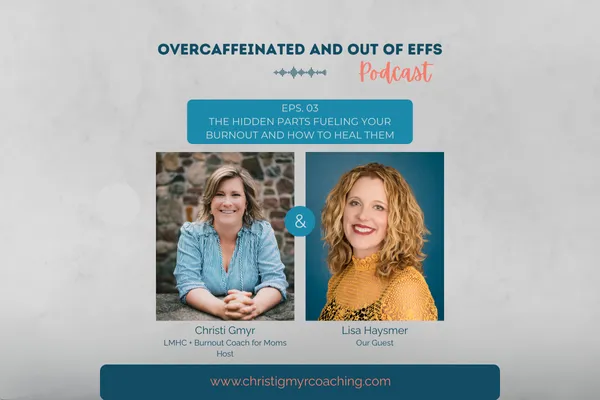
EPS. 03 Lisa Haysmer - The Hidden Parts Fueling Your Burnout and How to Heal Them - Transcript
Episode 3: Lisa Haysmer – The Hidden Parts Fueling Your Burnout and How to Heal Them - Transcript
[00:04] Christi Gmyr: Welcome to Overcaffeinated and Out of Effs, the podcast for burned out, career-minded moms who are ready to stop pretending everything's fine and feel like themselves again.
[00:15] I'm your host, Christi Gmyr, burnout coach for moms, licensed therapist and mom of two. And I'm here to help you reclaim your energy, your identity, and your peace of mind.
[00:25] Whether you're lying awake thinking about the 87 things you didn't get done or silently resenting the people you love most,
[00:32] This is your space to feel seen, supported, and not so alone.
[00:36] So grab your coffee, hot, cold or day old, and let's get into it.
[00:48] Hello and welcome to Overcaffeinated and Out of Effs, the podcast for stressed out, emotionally exhausted,
[00:55] career minded moms who are tired of pretending everything is fine and ready to feel like themselves again.
[01:02] I'm your host, Christi Gmyr, licensed therapist and burnout coach for moms.
[01:07] In today's episode, I'd like to welcome our guest, Lisa Haysmer.
[01:12] Lisa is a licensed therapist in Michigan and an energetic business consultant that helps her clients develop financially, emotionally and spiritually fulfilling businesses.
[01:23] Her passion is teaching others how their early attachment wounds not only impact how they feel about themselves,
[01:29] but also what life events they attract to them, including their careers and businesses.
[01:35] By incorporating energetic tools and experiences in a unique way,
[01:40] her clients can overcome the limiting beliefs that have been holding them back from the professional and personal lives they want to live.
[01:47] With self doubt and burnout obstacles out of the way,
[01:51] they can successfully shift their career or business path to create the finances and freedom that makes their hearts sing.
[02:00] So I have invited Lisa here today specifically because she's going to talk a little bit about her work with the the IFS or the internal family systems model of therapy and how it relates specifically to overcoming burnout for all you working moms out there,
[02:20] specifically the idea that Tahiti heal burnout. We need to be honest about parts and then recognize how we are unintentionally attracting or manifesting more of the same things that are burning us out.
[02:33] So welcome Lisa. Thank you so much for being here.
[02:37] Lisa Haysmer: Thank you so much for having me. I know that's quite a mouthful I gave you there.
[02:43] Christi Gmyr: Yeah, no, but this is great. I think that it's always so great when listeners can, you know,
[02:48] understand who's. Who's speaking. And I think that you are going to bring some really great things to the table. I'm super excited about our conversation today and with that in mind, I mean, do you want to maybe just start off by telling us a little bit about your story and,
[03:01] you know, how you got into this work.
[03:04] Lisa Haysmer: Sure.
[03:07] So I've been a licensed therapist for like 20 coming up in 26 years, believe it or not.
[03:16] Worked in a bunch of different,
[03:19] you know, types of agencies and whatnot, and then started private practice.
[03:28] I will say that despite being a therapist and working in that field for so long, I didn't really start my own,
[03:37] like self healing journey and really starting to understand myself until I became a mom.
[03:43] Right. And like suddenly we have this greater sense of awareness and of all the **** that we're like bringing into our family system.
[03:53] And so that was like, when I started really starting to look at myself,
[03:58] really starting to over time get curious about my personal sense of spirituality, which to me is very different than religion.
[04:09] Um,
[04:10] and that just led me on this like, healing, self healing journey of like my own therapy, but also just kind of this spiritual and energetic exploration.
[04:20] And then the pandemic hit.
[04:23] And it's interesting because prior to the pandemic I was,
[04:31] I don't think I was at burnout yet, but I was starting to like, have this inkling of like,
[04:37] I kind of want something more. I don't know what it is. I kind of want to teach, but I don't want to teach at like a college or something like that.
[04:45] That sounds,
[04:46] you know, I don't want to deal with red tape and stuff like that. I want to teach on these kind of weird, interesting subjects and I want more time, I want more freedom, I want more fun people, whatever.
[04:58] And I was kind of just brainstorming. And then the pandemic hit and through a very interesting series of events, I got an email delivered to my email box from somebody's list that I had gotten on that said, have you ever thought about creating an online course?
[05:17] And I was like,
[05:18] huh, well, No, I have not.
[05:21] But it like checked so many of my, the boxes that I was looking for like six months before.
[05:28] Um, and so at that point, like, oh, okay, I'm gonna start like creating online content and creating an online course.
[05:35] And I've really just not let go of that ever since.
[05:40] So I'm kind of always doing both things, Always doing the therapy stuff, but then also figuring out new ways to bring information to people who maybe aren't necessarily needing therapy, but always looking to grow and understand themselves and work on things like burnout.
[05:59] Christi Gmyr: Right.
[06:00] Lisa Haysmer: I always say, like, there's not like a diagnosis for burnout. So not everyone, you know, therapy is not the right thing for everybody. All the Time.
[06:08] Christi Gmyr: Yeah. No, and I absolutely agree with you. I mean,
[06:11] similar to you. I mean, I. I made some similar decisions with my career path, but.
[06:17] But the reality is, is that coaching and therapy are different. And coaching and consulting can be great ways, you know, to really reach out and try to help other people in ways that maybe, maybe if they're maybe like a mental health diagnosis isn't necessarily going to apply and things like that,
[06:37] but they're still needing help and they're still needing support. So I'm so glad that you found that for yourself.
[06:43] Lisa Haysmer: Yeah, you too. I'm glad.
[06:47] Christi Gmyr: Thank you.
[06:48] So. So I know you had mentioned that you really do a lot of work, you know, specifically around, you know, ifs with therapy. And, you know, you had talked a little bit about burnout being connected to this parts work.
[07:03] And for those people who maybe aren't familiar or who really haven't heard of this before, I'm wondering if you can just explain a little bit about what that means and how moms can recognize when different parts of them are in conflict and then even more specifically how it might show up or apply to burnout.
[07:21] Lisa Haysmer: Yeah, absolutely.
[07:23] Um, so the way that I try to nutshell parts work or ifs,
[07:32] which they might hate me for explaining it this way, but it's the way that, like, I feel like, makes sense is lots of us, I think, are familiar with the inside out movies, right?
[07:43] They had the first one, which I loved, and then they came out with a second one and I was like, oh, my God, this one is extra awesome.
[07:50] So in those,
[07:51] you know, Disney Pixar movies,
[07:53] it's the girl and she has these little people inside her head, all of her different emotions.
[08:00] And we really start to appreciate how each of those little people inside her head are all trying to help her, right? And they're just going about it in very different ways from each other.
[08:12] But they all have her best interests in mind.
[08:16] So I like to think about ifs or parts work as kind of like that, except unlike the movie,
[08:25] we can actually connect with and kind of have a conversation with each of our little parts. And it doesn't mean we have multiple personalities. It doesn't mean we're crazy.
[08:36] We're just like tuning into these different aspects of ourself.
[08:44] And so in the movies, you know, there's like sadness and there's anger and anxiety in ifs or when we think about parts work, there's. There's way more than those, right?
[08:56] So, yes, we have those parts. But when I think about moms and burnout and things like that. I'm like,
[09:07] we might have parts in us that carry a belief that says,
[09:12] I have to do everything perfectly,
[09:15] otherwise the whole world's going to fall apart.
[09:18] We might have a part in us that says,
[09:23] I have to keep everybody happy all of the time.
[09:28] We might have a part that says,
[09:31] God, no matter what I do, like, it's just not ever good enough. Like, how come I'm never good enough?
[09:37] We might have a part that says,
[09:40] no matter if I'm in my family or I might. I'm at my workplace, like, God, I. Why do I always feel alone? I'm always alone. How. Why am I the only one that ever hears whatever?
[09:52] So each of those we can look at as parts in us that chances are we kind of developed or adopted, if you will,
[10:05] probably at a young age. It just looked different when we were young.
[10:10] But they just,
[10:12] again, kind of like similar to the movie. They're all trying to help us. They all are trying to help us figure out how to get through life.
[10:21] They just don't always agree what the right way is.
[10:26] And it, you know,
[10:29] I. I often feel like it only halfway works, right? So if I have a perfectionist part,
[10:36] I can sometimes do things really, really well and maybe almost perfectly. And it kind of works until the next time when it doesn't. And then it, you know. So none of our parts are going to work all of the time for us.
[10:50] But when we are feeling really stressed
out, or God help us if we get all the way to the point of feeling some burnout,
[11:02] I think one of the best things we can do is to get clear on what part of me is working extra right now, what part of me is kind of working overtime.
[11:16] Once I know which part of me, which belief I have that's going on is working extra,
[11:23] then I know the right thing to do to try to help bring some. Some peace, some healing to that part, if you will.
[11:33] That makes sense. I know that's kind of like.
[11:35] Christi Gmyr: Yeah, yeah. No, I mean that. That's really helpful. Thank you for explaining that. And I like how you talked about the movie so people can sort of conceptualize it, you know, in that way.
[11:44] Maybe makes things feel a little bit more digestible.
[11:49] So in your experience. And how would you say that early attachment wounds shape the careers, the roles, the responsibilities that women do take on later in life, especially as moms.
[12:04] Lisa Haysmer: So my current hypothesis. Hypothesis meaning, like, it's going to always change in flow, right?
[12:13] Is that all of us,
[12:17] no matter how we're feeling or what behavior that we have, we're always coming from a place of motivate, being motivated by, I have a desire or need for love,
[12:31] I have a desire or need for safety,
[12:34] or I have a desire or a need to have value in the world.
[12:39] And so when we're very young,
[12:43] I think we start to,
[12:47] depending on our family situations, we start to figure out different ways where we can feel safe, different ways where we can feel love, and different ways that we feel valued as women and especially as moms now.
[13:03] But when we're young, I think,
[13:05] you know, females in our society are often very much encouraged to be caregivers, to be nurturers, to care about other people,
[13:14] which is obviously not a bad thing. Right. It's an awesome thing. We need that we're not always taught enough of how to pay attention to ourselves and our feelings and our needs.
[13:29] And so if I look at myself as like an example,
[13:34] I can say I absolutely,
[13:36] without realizing it, went into this profession because I felt the way in which I got love and attention in the world from a young age was paying attention to my family members and then even in elementary school, like my friends,
[13:54] that when I helped them,
[13:55] I got love in return.
[13:57] Right. So it just became this sort of natural progression of, oh, okay, I guess this is what I'll do for a living.
[14:05] Which is not a bad thing.
[14:07] But again, if we're missing out on the knowing how to pay attention to ourselves and like,
[14:16] you know, again, our deeper needs, our deeper feelings, whatever,
[14:21] because we're so often paying attention to other people, if we missed out on paying attention to ourselves,
[14:27] then down the road, I think we end up being at risk for things like burnout because we've ignored so much.
[14:36] Christi Gmyr: Well, and I think, you know, to go along with that also, you know, I. I do think that once we have kids, for a lot of us, that also,
[14:47] you know, can affect, you know, because we. We really,
[14:52] you know, adopt these roles that you're talking about. And I think that a lot of times when we do take on that mother, for a lot of us, that becomes very all consuming, you know, and there can be this huge shift where a lot of moms might struggle with losing their identities from before that,
[15:11] you know, and so. And a lot of times they might start to feel like they don't know who they are anymore. And I think a lot of times it sort of happens over time, and they just kind of like wake up one day and realize, like, hey, you know,
[15:23] and start wondering, where,
[15:25] where did that go? Like, I. Where did my identity go from before?
[15:29] And so I'm wondering, like, how can understanding our inner parts help with moms to reconnect with that core identity?
[15:40] Lisa Haysmer: I think that obviously the.
[15:47] On a case by case basis, right? It's looking at when did I lose myself?
[15:54] You know,
[15:56] which can vary with like, how young we became moms or how old we were when we became a mom.
[16:02] If we're involved in a significant relationship, like, when did that start?
[16:06] Because obviously we can run the risk of losing ourselves a little bit there.
[16:12] So again, it's like getting curious with when these big life changes have happened was how, how good it was I at paying attention to myself before them?
[16:27] How good am I at paying attention to myself now?
[16:33] I think that again, it's like if nobody,
[16:37] if nobody teaches us how to pay attention to ourselves,
[16:44] we don't even know that we're missing it. Like, if I, again, I, I use myself as the example a lot because it's just easier to illustrate points. But like,
[16:52] I was a therapist and if you asked me at a young age if I had self awareness, I'd be like, yeah, I can tell you all about me.
[17:00] I now look back and I'm like, I had no idea about some of my, the deeper stuff that I was holding onto that was affecting me, but I just wasn't aware of it again until I became a mom and then was like, oh, I guess I better start paying attention.
[17:19] Christi Gmyr: Yeah, no, I, I definitely hear you. It's interesting the things that we start to learn about ourselves as we go through lives and to add through our lives. And to your point, as therapists in particular, you know, we're, we're obviously encouraged to do a lot of that work.
[17:32] And there is a lot of learning that happens. And yeah, it's amazing some of the things that can be discovered later.
[17:38] One of the things that, you know, you were talking about, you know, you say that we sometimes unintentionally attract or manifest more of what burns us out.
[17:49] Can you talk a little bit about that, like what you mean by that and just share some examples?
[17:54] Lisa Haysmer: Yeah, absolutely.
[17:57] So I feel like the word manifesting can gets thrown around a lot lately,
[18:04] which is not a terrible thing, but I don't know that it is always explained as fully as I would like.
[18:12] So some people use the word manifesting. I talk about it as the law of attraction.
[18:19] Same thing, just different wording.
[18:21] So with law of attraction,
[18:23] the idea here is that the energy we put out into the world is what we attract back to us,
[18:30] like a magnet all of the time, whether we're intending to or not.
[18:35] And it's thought of as the law of attraction in the same way that there's, like, the law of gravity.
[18:44] So every time I drop my coffee cup to the ground, it's going to fall to the ground 100 of the time, because that's how gravity works.
[18:52] Law of attraction is like, same thing.
[18:55] And I think a lot of times people are just not aware,
[18:59] again, that it's happening all of the time when. Whether we're intending to or not,
[19:04] and that it's based on how we feel,
[19:07] not just with our words and what we're saying.
[19:11] So lots of times when people are thinking about manifesting, they're talking about,
[19:16] oh, I have this vision board or I have a mantra that I'm reciting.
[19:21] And it's not that those are bad things,
[19:24] but if our feelings don't match those things,
[19:27] then,
[19:28] you know, that's where trouble comes in, because it's operating off of how we feel, what we believe,
[19:35] and not just what we're saying.
[19:39] So going back to your question,
[19:44] part of what I realized again, in. In my own healing journey was that very concept that's coming from what I'm feeling and not what I'm saying.
[19:58] The.
[20:00] The parts that, again, we're all carrying with us, that are all trying to help us,
[20:07] because the parts are. Are basically our feelings. So again, if we're thinking about inside out, like they're the feelings or our beliefs that we hold,
[20:16] and if that's what law of attraction is operating off of, it means that our parts are what basically is putting the energy out there.
[20:27] The tricky thing,
[20:28] or one of the tricky things is a lot of times,
[20:33] again, we're not necessarily aware of our parts if we've not been taught how to.
[20:37] But also those early attachment experiences that we've had, we don't always realize that impact that they have on us,
[20:47] especially if there's not been something, like, horrific that's happened.
[20:53] So a lot of times when there's really overt abuse or neglect, which is awful, obviously, but when that happens, at least people are maybe a little bit more aware of how that stuff has impacted them.
[21:07] When there's not overt OBI abuse or neglect, and there's just imperfect families, imperfect parenting,
[21:17] we can become unaware of how that stuff has shaped us and made us believe different things about ourselves.
[21:27] So,
[21:28] again, if I use me as the example, like when I was growing up,
[21:35] if I got a bad grade on a report card,
[21:39] my parents did not flip out. I did not get hit. I did not get beat. They kind of were just like, oh, okay, let's work on that better.
[21:49] However,
[21:50] my parents in general were pretty absent emotionally and not really attuned to me or my siblings kind of at all.
[21:59] And so it's not that I got in trouble if I got a bad grade, but what I instead learned is that when I get a really good grade, when I have a really good report card, oh, that's the only time that they actually pay attention.
[22:11] Okay,
[22:12] so I'll just keep getting good grades all the time. I'll just keep performing well all the time. I'll just not be perfect. But like, I have to keep performing otherwise I don't get
any attention at all.
[22:23] So it's was such a subtle thing. And again, it's not what I'm describing there is not horrible and awful and abusive.
[22:32] But as an adult,
[22:33] guess what? I became a, an adult that became afraid of not performing or not doing well.
[22:40] Because if I don't, people are not gonna pay attention to me. They're not gonna notice me. They're not gonna.
[22:48] So going back to that energy stuff energetically,
[22:56] if what I'm putting out there is I'm,
[23:01] if I'm imperfect, if I don't do well, people are not going to notice me. They're not going to pay attention to me. Then energetically, what I might attract to me in the workplace is bosses that huh, don't seem to notice me if I,
[23:17] unless I'm doing something extraordinary or ignore all around. You know, it's,
[23:24] um,
[23:25] can be tricky to track the patterns.
[23:29] Um,
[23:30] but what I often do with clients is like, if you tell me about why you don't like your workplace or why at home you're stressed out,
[23:40] chances are I'm like, I can track it back to a similar belief or a similar experience that you had when you're growing up.
[23:49] And a lot of times,
[23:51] you know, as therapists we, we look at that from more of like a psychology perspective of like. Yes, we, we find partners that remind us of, you know, how we grew up.
[24:03] And that I think is still true. I don't disagree with that.
[24:07] Where I see the energy stuff playing a little bit bigger role is like things that are harder to explain,
[24:16] harder to have a rational quote unquote explanation for the,
[24:25] the. One of the examples I guess that I like to share, which doesn't sound, it's not, I guess exactly, you know, worker home life related,
[24:33] except for it was literally about my physical home,
[24:38] is that a number of years ago My husband and I were trying to buy a new house,
[24:45] and it was during the pandemic.
[24:49] For anyone that knows, like, that was a crazy time to buy a house. Like, things. The market was just insane.
[24:57] And if you asked me logically,
[25:01] Lisa, do you deserve a house? I would say yes, because here's my money in the bank, and here's our, you know, pre approval and all this stuff.
[25:10] We literally were looking at houses for about two and a half years,
[25:16] making offers on houses tens and tens of thousands of dollars above the asking price and getting rejected all the time.
[25:29] And at some point, I was like, okay,
[25:32] this doesn't make sense. I have to, like, figure out,
[25:35] Lisa, you believe in this energy thing. Like, I seem to be manifesting. There's a block in the way that's preventing me from manifesting this house. Let me, like, get clear on it.
[25:48] So I sat down,
[25:50] closed my eyes, because this is how I tune into my parts a little bit better as I close my eyes.
[25:55] And I was going to imagine myself in my new house,
[26:02] and not in the way that a lot of times people think about with manifesting. They'll say, like,
[26:07] picture what it looks like and visualize what it looks like. I wasn't trying to visualize. I wanted to get clear on my emotional **** that was getting in the way.
[26:16] So I imagined myself in the new house and like, all right, what does it feel like, Lisa? You know, every. All the energy stuff has to do with feeling. What does it feel like?
[26:25] So I was like, oh, it's.
[26:27] I like whatever. I love having this big kitchen. I like that we have a pretty yard.
[26:33] I like that there's all this extra space.
[26:35] I love how it's decorated. I can't believe I get to live here.
[26:40] And as soon as I said that, I was like,
[26:43] what?
[26:45] I can't believe I get to live here.
[26:49] And I caught that, and I said,
[26:51] wait a minute. Why would you not believe you get to live here?
[26:55] Mm.
[26:56] So, again, because I'm sitting there with my eyes closed and kind of tuning into parts.
[27:03] This is not coming from a logical place. This came from some very vulnerable part inside me.
[27:09] The moment I said, wait a minute. Why would you believe you don't get to live here?
[27:14] Instantaneously, I had this part that answered very quickly in my mind that said,
[27:21] Lisa, you can't even get your mom to love you. Why would you believe you deserve a house?
[27:26] And as soon as I said that, I was like, holy ****, like, what?
[27:31] And I just started crying,
[27:34] but allowing myself to cry, because this part Believed that this part in me believed that I don't deserve good things. Because, Lisa, you get what you need. You don't get extra.
[27:46] You have a house. You don't get to have an extra nice house.
[27:50] Because that's what that part of me learned growing up. I had my needs met.
[27:56] I'm not allowed to ask for extra. I'm not allowed to ask for what I desire.
[28:01] So I.
[28:03] Just curious. Yeah,
[28:05] Yeah.
[28:05] Christi Gmyr: I mean, it sounds like you had this, you know, this discovery, and. And I imagine that you. You said two and a half years, so you eventually did move into a house.
[28:13] I'm curious. Once you have that realization,
[28:16] how did you then use that knowledge and insight, like, what did you then differently. To help you then?
[28:23] Lisa Haysmer: Yeah.
[28:24] So I just sat there and allowed that part to cry. And again, like I was describing earlier, like, almost like this dialogue between the part that needed to cry, that believed that and me, the.
[28:37] The truest me and my soul, if you will,
[28:42] and then kind of was, like, reassuring of, like,
[28:45] kind of consoling that. That little kid part of me sending it compassion and love. And I ended that little session of just me sitting there.
[28:57] Two and a half weeks later, we got our house.
[29:00] Christi Gmyr: Wow, that's amazing.
[29:01] Lisa Haysmer: And what did I do differently? Not a thing.
[29:06] Not a thing differently than I already hadn't already was doing with all of the other houses.
[29:12] So energetically, what happened was by bringing some compassion to that very vulnerable part and just, like, sending it with love and saying, like, oh, my gosh, I'm so sorry, you've learned to believe that you don't just get to what you have, what you desire.
[29:26] That's really unfair that you had to believe that.
[29:30] And just by sending it that compassion and allowing it to shift a little bit,
[29:35] it changed the energetic obstacle that was kind of in the way there. And then I got the result.
[29:43] Christi Gmyr: Yeah. No, that's amazing.
[29:45] Well, so then if we were to take some of those ideas and practices and, you know, apply it to the burnout that a lot of working moms are experiencing,
[29:55] like, what would you say are some energetic tools or practices that can help those moms to shift out of burnout? Um, especially because so many moms have felt like they felt like they've already tried so many different things.
[30:07] A lot of them feel like they've already done everything and there's just no way out of this. And so what would be some suggestions that you would have for them?
[30:16] Lisa Haysmer: Yeah,
[30:17] um, I would actually suggest almost the same thing that I was describing there, although mine was about a house, but is sitting down with themselves and, like, getting curious about what part of me is feeling this burnout.
[30:34] Is it the perfectionist part? Is it the part of me that is constantly juggling and. And not knowing how to take time for myself? Whatever. Whatever the part is,
[30:44] and then thinking in kind of the inside out,
[30:48] you know, perspective,
[30:52] letting that part fit,
[30:53] feel whatever it's feeling, whatever belief that it's carrying and meeting it with compassion.
[31:02] The way that we would offer great compassion to a small child. Right. Of like, just giving it comfort, giving it love.
[31:13] And instantly when we start to do that, we're already creating a shift.
[31:21] And then I like to. So this part wasn't in, you know, my example, but I like to try to look for proof, if you will, that. That an energetic shift has happened.
[31:41] So mine cleared up really quickly and I got a house really quickly. But, like,
[31:46] I like looking for pieces of proof that I'm now sh. I've shifted and I'm starting to attract different things.
[31:54] So if the cause of somebody's burnout is,
[31:57] you know, they're working 80 hours a week and, you know, trying to do the mom stuff as well,
[32:05] it doesn't mean that all of a sudden, like,
[32:07] Mary Poppins is going to show up on their doorstep and, like, take care of all the house stuff,
[32:12] but.
[32:13] But of getting them to get curious about watching for your husband suddenly doing the dishes, even though it's not his day,
[32:23] watching for Sally at work, volunteering to take something off your plate,
[32:29] off your task list that, like, wouldn't normally happen. So it's like watching for the smaller things because each time we're noticing the smaller things,
[32:39] we're kind of building the momentum, if you will. So it's like a snowball rolling down the hill, but in a really good way.
[32:46] Yeah. If we watch this for the smaller pieces of evidence, it just.
[32:51] It kind of creates this proof of, like, oh, okay, so the more I show up with compassion,
[32:56] the more things actually start to unfold in a better way, that it feels easier and better to me.
[33:02] Christi Gmyr: Well, and it sounds like then once you see that evidence, again, proof that this is working. Right. And then it sounds like it, sir. You talk about building momentum, but it sounds like it sort of gives everybody that, you know, encouragement to.
[33:16] To keep going with it.
[33:17]
Lisa Haysmer: Right? Yeah.
[33:18] Christi Gmyr: That's how it turns into that snowball.
[33:20] Lisa Haysmer: Yeah. Because once you see it slowly starting to work, you're going to get even more incentive of like, oh, yeah, I really do need to, like, prioritize.
[33:29] Tuning into me, which I know. Is so, so hard for moms. Right. Like again, because we're like doing all the juggling,
[33:37] it feels like a luxury sometimes to like create time to really pay attention to ourselves. And I'm like, oh, please don't make it a luxury. Like it's so, so, so necessary to do it really for the good of all.
[33:53] But like,
[33:54] mostly because we deserve it.
[33:57] Christi Gmyr: Yeah. Well, and I'm curious, you know, I'm listening to you talk about things like perfectionism and, you know, these other things. What are your thoughts about self doubt? I know self doubt is something that so many moms struggle with, especially because of this tendency to compare, you know, with social media.
[34:13] We're just,
[34:15] I feel like self doubt comes up a lot for, for working moms. And so what role would you say? What do you think it, the role is that it plays in keeping moms stuck in that burnout and then how can they start to energetically release that,
[34:31] oh, self doubt. Ugh.
[34:36] Lisa Haysmer: Self doubt, I feel like is actually at, in a weird way, I feel like it's actually at the root of perfectionism. People pleasing. Like it's at the root of all those other things.
[34:51] Christi Gmyr: Yeah.
[34:52] Lisa Haysmer: Because to me,
[34:54] what self doubt says is who I am is actually not good enough.
[35:00] And so I'll either be perfect to combat that or I'll please everybody to combat that.
[35:08] So I think that that's the root of everything.
[35:13] But coming back to your question of like, so what do we do about it?
[35:18] I think that again, it's, it's the looking at,
[35:27] where did I start believing that who I am isn't good enough? Where did I start believing that if I do something wrong,
[35:39] it means something bad about me as a person?
[35:44] Because I feel like that's the kind of stuff that, like when we're in a job where we're really getting burned out at that self doubt is the thing that's keeping us from asking for a raise or from setting different boundaries with ourselves at work and, and with our co workers and whatever.
[36:04] Right.
[36:05] The self doubt is saying don't set boundaries because then you're going to get fired. Don't set boundaries, people are going to get mad at you. We're not allowed to have people mad at us.
[36:13] So it's the, like getting really clear on where did I believe that if I set a boundary and people get mad at me that that's not tolerable? People might get mad at me,
[36:28] but why is it not tolerable to me?
[36:30] Christi Gmyr: Well, and it sounds like, you know, a lot of,
[36:34] you know, self exploration, you know, just really sort of sitting with all of this and to try to identify, you know, more specifically what's going on and what's leading to, towards some of these things, it's going to be really the key to all of this.
[36:46] But I'm curious for people who are trying to, you know, are maybe still having a bit of a harder time really understanding or not entirely sure, like, where to start.
[36:57] I'm curious if you can share an example of like a very, just simple technique, very simple mindset shift, you know, something like that that moms could try today if they wanted to, to start shifting their energy around burnout.
[37:12] Lisa Haysmer: And without me trying to like, sound redundant,
[37:16] because I totally hear your question.
[37:19] What I have found both for myself and when I do this with clients, whether it's therapy clients or coaching clients,
[37:30] if you, if somebody has not experienced this themselves, they're going to think I'm making up and I'm not.
[37:38] But like, for,
[37:40] like,
[37:41] for somebody that's listening right now,
[37:43] if they, in this moment,
[37:46] were to close their eyes for a second, because when our eyes are closed, we just tune into ourselves a little bit better.
[37:53] If you thought about a thing that you are stressed out about today,
[37:58] right in this moment,
[38:01] and you just noticed that stress and you notice what it feels like in your body, maybe, or what it feels like emotionally, because maybe it feels like anxiety, maybe it feels like frustration, who knows?
[38:18] But just noticing what it feels like and then just saying this stress, this anxiety, this frustration is allowed to be here right now.
[38:32] I'm allowing it to be here and I accept that it's here.
[38:38] It doesn't have to go away, it doesn't have to change,
[38:41] it doesn't have to do anything different.
[38:44] I'm just allowing it to be here and I'm meeting it with acceptance,
[38:51] maybe compassion.
[38:56] What I notice in myself and when I do it with other people is that the minute that happens much of the time, not a hundred percent.
[39:06] As soon as we accept that it's here and we are honestly allowing it to be here for a minute,
[39:12] people will often say, like, ooh, I just like melted a little bit. Like, they notice a little tiny bit of instant relief.
[39:22] That's a shift.
[39:24] So, like,
[39:25] I know that it is hard and they, and as moms, we feel like, I've tried everything I've done this, this, this.
[39:32] There is something different that happens when we just for 20 seconds, show up for a part of us and just let it be there and, and not pushing against it.
[39:45] Sometimes we do have other parts that do want to push against it. And, like, I get that that happens a lot of times, too,
[39:51] but most of the time,
[39:53] it is just, like, letting it be there instantly gives this little tiny shift of, like,
[40:00] relief,
[40:02] because all of those parts just want.
[40:05] They're all trying to help us. Right. Like I was saying at the beginning, and they just want to know that we know that they're there and that they're trying to help us.
[40:13] Yeah. As soon as we recognize them. It's a. It's a thing that people. Moms can experience in their body.
[40:21] So that's like. It's a cool thing to know that it's working because we feel it in our body. Like, there's a little piece of relief there.
[40:30] Christi Gmyr: Yeah. No, and I think that that's a really important thing to point out. I think that it's really helpful because I do think that for a lot of people, there can be this tendency to try to push back against it, you know, that sort of thing.
[40:42] And what you're talking about is, you know, don't do that. Instead, just sort of accept it, embrace it, give it the space,
[40:50] and then. And then it might just naturally lift on its own.
[40:54] Lisa Haysmer: Yeah,
[40:55] it's.
[40:57] You know, this is such a silly example, but I. This is how it makes sense in my brain.
[41:02] I know that in my marriage,
[41:05] when I'm frustrated,
[41:09] if my husband and I have a disagreement about something and he could, like, really quickly be like, I'm sorry, and, like,
[41:16] he's done with it. And I'm like, no, listen,
[41:19] we're not done until I get to tell you all of the ways in which I am frustrated.
[41:25] And once I can say all that, like, and I know that you get it,
[41:30] okay, now I can move on. Right.
[41:32] So it's kind of like that. Of like, our parts,
[41:36] if we try to brush them off or we try to shush them, even if we're doing it nicely,
[41:41] they are not going to go away. They're maybe going to get louder. And so it's like, if. Just like with me and my husband, like, if we just give them the space to say what they need to say and they feel heard and understood, they're like, okay, I just needed to know that you got that they're willing to laugh.
[42:00] Christi Gmyr: Yeah, no, that. That makes sense.
[42:03] And so I'm going to shift just a. Just a little bit. I wanted to ask you a little bit about, you know, I know with your work in particular,
[42:11] you help people, you know, with their businesses. You know, you help clients Develop. You had said financially, emotionally, and spiritually fulfilling businesses.
[42:20] A lot of moms feel burned out,
[42:24] and they. They feel fulfilled. At the same time, they fulfill. They feel fulfilled in their roles as moms. They feel fulfilled in their job and their careers,
[42:34] but that's not always the case. Right. And so I'm curious, like, what advice do you have for moms who are feeling burned out, but also they're feeling unfulfilled in their work?
[42:43] Mm.
[42:44] Lisa Haysmer: Yeah. Again, I'm like, curiosity of, like, are you unfulfilled in your work because you chose the wrong career path?
[42:55] Christi Gmyr: Mm.
[42:57] Lisa Haysmer: Are you unfulfilled because you're in a toxic, icky environment and you've been taught to just accept toxic,
[43:07] icky environments?
[43:10] Are you just looking for change and, like, you want something new that, like, sparks you?
[43:15] Right. So again, it's like leading with curiosity. But what part of you is feeling burned out? Is it the part that is lacking creativity? Is it the part that believe she's just supposed to exist in a toxic environment?
[43:32] Is it the part that's like, oh, I just picked the whole wrong career field. I hate this work.
[43:38] Right. And it's just allowing those parts to have permission to say, I actually hate my job or,
[43:46] I love my job. I just hate this part. Right. And we're allowed to have space for the parts that oftentimes think things that we wouldn't want to say out loud.
[44:01] Parts are in there, and they still think those things. Right. They can think like, I know I'm a teacher and I'm supposed to love kids, but
I've actually discovered I hate kids.
[44:10] I don't want to be with them. Right.
[44:13] That part just needs a little bit of space to say that sometimes.
[44:17] Christi Gmyr: Well, as let's say, you know, they take the space, they step back, they think, you know, they ask themselves these questions, and they pay attention to all of that, and they discover that,
[44:27] you know what? I do need some sort of a change.
[44:30] You know, maybe they're thinking they want to shift their careers or their businesses, you know, something like that.
[44:36] But again, burnout. You know, the idea of making a big change can feel so overwhelming,
[44:43] you know, especially if you are already struggling, you know, and so what would you suggest for people who are maybe in that situation, what would be a good place for them to start if they were looking to shift their careers or their businesses?
[44:58] Lisa Haysmer: Yeah.
[45:00] Do you believe that you're allowed to ask for help?
[45:05] Right.
[45:06] So whether because shifting a career or starting a new business, obviously, like, those are both really big things.
[45:17] Mm. Do I believe my. I'm allowed to ask for help both in terms of logistics, in terms of, you know, childcare maybe changing or finances changing,
[45:31] but do I believe that there's help available to me to guide me in making decisions? Do I believe that there are good people out there,
[45:42] therapists, coaches, whomever that are there to help me, could. That could guide me?
[45:49] Right. Because again, it's like sometimes as moms especially, who are doing all the things,
[45:56] we're the ones that are doing all the things we don't. We're not always great at asking other people for help.
[46:03] And do I believe I'm allowed to. Do I believe it's available to me, or have I adopted a belief that I'm all on my own?
[46:11] Right.
[46:12] Christi Gmyr: Yeah. Yeah. No, I think that that's great. And I mean, I have to say I think that this has all been super informative. It's been super helpful. I. I feel like I could go on and on and on, and we could probably have a conversation about this all day.
[46:25] But I. I also want to respect your time and the time of the moms who are listening. And so for those who are listening, who are interested in, you know, learning more about this, learning more about your work, learning more about you.
[46:37] Where can they do that?
[46:39] Lisa Haysmer: Yeah. So I have a.
[46:43] A tool that I, you know, wanted to offer to your audience for free.
[46:48] It's just a simple checklist to kind of check in on their burnout. So it's a checklist. And then some. Some of the tips that I was covering today,
[47:00] it kind of goes into some explanation about, like, what to do with, you know, if you are having some burnout, like, how do you start to shift it? What does that look like?
[47:11] So it really is just like I called it burned out and blocking your flow. So we're blocking the flow of the energy.
[47:19] And so, you know,
[47:21] absolutely. That's welcome to all of your audience.
[47:26] Great, thank you. And then I am,
[47:30] you know, I'm on Facebook. I have yet to get on Instagram, which is so silly. But it's just thing that I've been resistant to do that I really probably need to do.
[47:42] So people are welcome to find me on Facebook. I have a YouTube channel as well called the Spiritual and Sassy Therapist and Coach.
[47:54] And yeah, my website is just very simply www.lisahaysmer.com because let's just keep it simple.
[48:01] Christi Gmyr: Okay, great, great. And so I will obviously include all of that in the show notes for anybody who is listening,
[48:08] you know, and then I will also include the link to that checklist. And thank you so much for doing that. I think that's above and beyond. We appreciate it.
[48:17] Yeah. And so before we go, you know, before we wrap up for today,
[48:22] what is one final thing that you wish every burned out working mom knew about her, herself and her potential to heal from this?
[48:34] Lisa Haysmer: I'm, like really pausing in your question of that and like, really feeling into it because it feels like such an important question.
[48:45] I think it's such a basic thing, but of saying you are deserving and worthy of feeling better and of having more balance and of receiving and not only giving.
[49:01] Christi Gmyr: Okay,
[49:02] perfect. That's so wonderful.
[49:05] Well, thank you again so much for being here. We really, really appreciate it. I. I really, you know, feel honored that you took time out of your day to come here and talk to me about this.
[49:17] For the moms who are listening, you know, if this episode was especially helpful or if it resonates with you,
[49:23] you know, I please encourage you to share it with other moms. You know, there are so many of you out there, you know, trying to get to as many and help as many as possible.
[49:32] And then you can also follow Lisa and her work again. I'll put that information in the show notes as always. And I'm also here to support you and you can find my information there as well.
[49:43] And just, you know, final note, I just always want you to remember mommying is hard. It is super hard.
[49:51] You are all doing great.
[49:52] You know, I know sometimes some days are harder than others, but really, you are all doing great and I hope you have a great day and I hope you all plan to listen next week.
