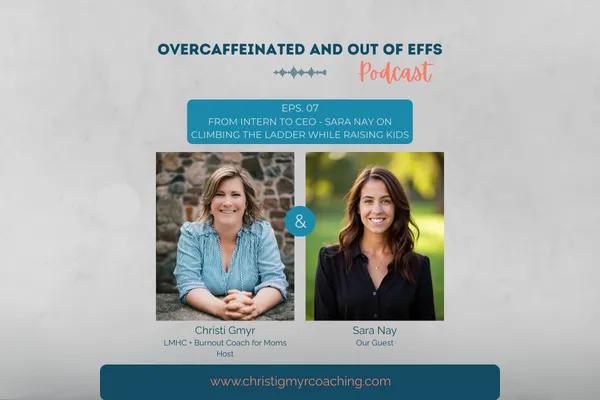
EPS. 07 From Intern to CEO - Sara Nay on Climbing the Ladder While Raising Kids - Transcript
Episode 07: From Intern to CEO – Sara Nay on Climbing the Ladder While Raising Kids - Transcript
[00:04] Christi Gmyr: Welcome to Overcaffeinated and Out of Effs, the podcast for burned out, career-minded moms who are ready to stop pretending everything's fine and feel like themselves again.
[00:15] I'm your host, Christi Gmyr, burnout coach for moms, licensed therapist and mom of two. And I'm here to help you reclaim your energy, your identity, and your peace of mind.
[00:25] Whether you're lying awake thinking about the 87 things you didn't get done or silently resenting the people you love most,
[00:32] This is your space to feel seen, supported, and not so alone.
[00:36] So grab your coffee, hot, cold or day old, and let's get into it.
[00:47] Hey, everybody, it's Christi.
[00:50] Welcome to Over Caffeinated and out of Effs.
[00:53] Today I would like to welcome our guest, Sarah Nay. Sarah. Sarah is the CEO of Duct Tape Marketing, where she helps small businesses turn marketing strategy into scalable systems their teams can actually execute.
[01:08] Since 2010, she's working with thousands. She's worked with thousands of business owners and fractional CMOs, blending big picture strategy with scalable operations.
[01:19] A passionate trainer at heart, Sarah's mission is to empower others to lead from their zone of genius and build marketing teams that can actually get the work done.
[01:29] Sarah is also the author of Breaking Free of Broken Marketing Models, with the mission to help small businesses take back ownership of their marketing instead of renting it.
[01:41] So I've invited Sarah here today because one of the main goals of this podcast is to offer support to working moms in a number of different ways and also to allow other moms to share their stories, just to help the other moms out there listening know that there are other people going through similar things and that we are not alone and that we're all in this together.
[02:04] And so I'm super excited for her to share her story as a working mom of two little girls, what led to her burnout and how she has been able to overcome it.
[02:14] So, Sarah, thank you so much for being here today.
[02:17] Sara Nay: Thank you for having me on.
[02:19] Christi Gmyr: Yeah,
[02:20] so you had said that you've been with Duct tape marketing for 15 years and you've worked your way all the way up from intern to CEO.
[02:28] And for starters, I just want to say that is. That is absolutely amazing. That's so, so impressive.
[02:33] Um, and I was wondering if you could maybe just start off by telling us a little bit more about yourself. You know, what that journey through your career looked like, especially while raising two little girls.
[02:46] Sara Nay: Yeah, absolutely. So, again, thanks for having me on and I appreciate that acknowledgment So I started at Duct tape marketing about 15, over a little over 15 years ago. Now,
[02:56] honestly, as an intern with no career path in mind, I didn't know exactly what I wanted to do. I was getting into marketing for the first time. So I had a lot to learn at that point about two things, business and also marketing.
[03:10] And so over the years, I fell in love with the clients that we serve in the small business space specifically. And so that's. That is definitely the drive that has kept me going over the last 15 years.
[03:22] But I've had a unique experience where I went from intern to community manager, account manager, fractional CMO for our clients,
[03:30] COO for our business,
[03:32] sales, and now finally in the CEO seat. And so I've learned a ton over the years about how agencies function.
[03:41] Um, I've learned a lot about all of those different roles.
[03:44] And it, ultimately, it's made me a better leader today because now I'm managing people in those different roles. And I know what it's like and I know what the stressors are, and I know what it looks like when someone's getting close to burnout, because I've walked in those shoes before,
[03:58] ultimately.
[03:59] Christi Gmyr: Yeah, yeah, well. And so you. You really know it from both sides. Right? So you've been in that position yourself, as you've mentioned. And then because of that, it sounds like it gives you a really unique perspective that maybe a lot of people in these top seats don't.
[04:14] Don't always have, which I imagine puts you in a great position to support,
[04:20] you know, other. Other moms who might be struggling.
[04:24] Now, you had mentioned having. You specifically said you've had these moments of, you know, too many burnout moments to count.
[04:30] And so I'm wondering, you know, if you can just tell us a little bit more about that, you know, maybe what sorts of things you noticed, how it got to that point, you know, what it really looked like for you, just how you knew that something wasn't right.
[04:43] Sara Nay: Yeah, absolutely. And. And I've had burnout moments as I identified, but I've also worked alongside a lot of other people that have burnout moments as well. And so we certify as part of our.
[04:53] Our program, other marketing agencies, fractional CMOs, consultants. And so I've worked with a lot of those people that are entrepreneurs themselves over the years,
[05:01] many working moms who've come to us because they were near burnout. And so we helped them transform from near burnout to actually enjoying their career paths again.
[05:11] And so this is all from personal experience,
[05:14] but Also from helping others get past that as well. But for me, you know, my biggest moment of burnout, and I wrote about this in my book that came out actually just last week in the intro is my biggest moment of burnout was six or so years ago at this point,
[05:30] where at that time, because we are a marketing agency, I was raising two young kids and then I was also managing a number of our clients in the account manager role.
[05:43] Um, but I was also managing a number of our implementation team.
[05:47] And I wasn't really in the spot where I would say was my zone of genius work.
[05:53] So I was managing too many people. I was trying to stay up with my family. I wasn't really doing work that inspired me or lit me up at that point.
[06:01] And so there was a moment actually, and I talk about this in my book, where I was holding my daughter, who's very young at the time, only a few months old.
[06:07] I was holding her on my chest and she was incredibly sick at that point. And she was this little six month old baby that was, you know, having trouble breathing.
[06:18] And while I was holding her, I was actually texting one of our clients, like behind her back, like holding my phone behind her back about something as silly as the shade of blue and like a social image.
[06:28] And at that point, you know, I put down my phone and I was like,
[06:32] I, I am pursuing this career path so I can be present for my kids. Like, that's always been my number one. But now I have my sick daughter and I'm not being fully present.
[06:40] So that was a big moment for me.
[06:42] And I actually ended up putting my phone down, gave my daughter, my husband, like, went on a walk out back behind our house because we have these amazing trails.
[06:51] And when I was out there, I was like, okay, something needs to change because I am so close to burning out and just walking away at this point. But I truly love what we do.
[07:00] And so I thought about, like, what do I need to put into place to get past where I am right now?
[07:06] And so I called our founder, John Jantz after I walked down from the trails and I was like, okay, something's gotta change. I'm not gonna be able to do this, maintain this any further.
[07:16] And so we did a bit of an analysis of what, how can we make these changes and where are my strengths and where do I enjoy the most in the work that we do?
[07:26] And so I was able to shift more into an operations role where I still did marketing strategy for clients, but not the, like the long term retainers because that's what was really challenging for me.
[07:38] And then we brought in fractional CMOs that could lead strategy and also account managers. So now we weren't expecting one person to fill both those roles like I was.
[07:47] And so I didn't want to just get out of the situation to put someone else into it,
[07:51] ultimately. And so we completely changed our business model at that point and really systems, processes, operations, building, company culture, communication, like, those are things that I thrive in.
[08:02] And so it got me out of the stuff that I don't excel in and into things that I really enjoy doing. And so all of a sudden, work was enjoyable again at that point.
[08:11] Christi Gmyr: Yeah. And, you know, it's interesting, like, listening to your story, you know, when you talk about that moment. I mean, I feel, I personally have always said for myself that one of the most stressful things, in my opinion, about being a working mom and dealing with sick kids,
[08:26] because,
[08:27] you know, it happened so unexpectedly,
[08:30] you know, they need our attention, we want to give them our attention. I think a lot of moms can really relate to what you're saying. This idea of,
[08:37] you know, I want to be present, I want to be there for my kids, but I have these other demands sort of pulling my attention away. And not everybody always knows how to manage it and what to do in those situations, you know.
[08:49] So I'm glad to hear that you were able to use that as a moment, like an aha moment. And it sounds like got a lot of support from. From work, which is amazing.
[08:59] And then in that. And then with those changes, just the fact that you were able to move into roles that felt more aligned with you, you know, anyways. And it sounds like that they were just like a better fit for you, especially with where you were
at.
[09:12] Sara Nay: Yeah, absolutely. And it was definitely my biggest moment. That was like a realization.
[09:17] And then ever since then, because I mentioned, you know, I've had multiple close to burnouts, like, that was definitely the biggest one for me because it was involving my kids.
[09:25] And so it was a big personal one for me. Um, but, you know, ever since then, you know, it hasn't been completely smooth sailing. You know, there's definitely been times, again, where it's not necessarily that I wasn't doing the right things, but I was doing too many things.
[09:37] And I think a lot of leaders and moms can. Can relate to that specifically. And so there also have been times where, you know, because I'm the type of person that goes, goes, goes, and then all of a sudden I'll get sick myself because I just like went, went,
[09:49] went, went, went and took on too much. And,
[09:51] and so now for me, when I'm feeling burnt out or spread too thin, like, I always try to take a step back and just say, okay, I can't say yes to everything.
[10:01] Like, how can I protect my time so I am not spread out tooth and across all of these different things. And just because I want to do all these things doesn't mean I need to be doing all these things.
[10:12] And so I do try to really strategize with my time and how it's spent moving forward because we do our quarterly business strategic planning and map out priorities and goals.
[10:22] And then I take on, you know, my own projects and things. And so when I'm feeling spread too thin, I always try to go back to that and say, what are the most important things that will make the biggest impact?
[10:31] And that's where I should spend my time versus all these other things on my to do list that are just sitting there.
[10:36] Christi Gmyr: Yeah, yeah, no, absolutely. And so just, it sounds like learning how to and giving yourself permission to say no instead of this obligation what to say yes. Which again, I think is something that a lot of moms struggle with for a number of different reasons.
[10:51] You know, just this idea of I can't say no or I shouldn't say no,
[10:55] but really a lot of times we need to be able to do that so that we can show up as our best selves in these other, these other ways.
[11:02] So again, you were talking obviously about, you know, your own situation and how you, you know, how it's really sort of shaped you and now you're in a position where you are leading other moms who might be struggling.
[11:14] So with that in mind, I'm curious, like, in your experience,
[11:17] what do you feel like makes burnout especially hard for high achieving moms just in general?
[11:24] Sara Nay: Yeah, I think high achieving moms put a lot of pressure on themselves. I do. At least I can speak for myself. Like I put a lot of pressure on myself because I want to continue to grow and I want to put a hundred percent into work, but I also want to put a hundred percent into my kids.
[11:37] And that math doesn't always work out exactly like that. And so I think a lot of it's, you know, self pressure, but also I think that finding companies that allow you to find some sort of work life balance is important.
[11:52] And so a lot of our team are moms and some of our team members even work part time because they want to, you know, be at school, drop off line in the morning and then they want to pick up their kid at 3pm and so they're working in between those hours.
[12:05] And so we try to give them permission to do that and to be present when their kids are at home. And so we're very flexible in that.
[12:13] We also just this month in August,
[12:16] decided to give everyone Fridays off so they could spend time because, you know, when you have kids,
[12:21] you are working during the week and then you're with your kids at night and you're to get all your errands you have to run has to happen on the weekends or wherever you can fit it in.
[12:29] And so we gave everyone Fridays off so they would have some time to really focus on whatever they want to do or need to do, if that's relaxing or if that's running errands.
[12:38] And so I think it's important to,
[12:40] you know, as, as leaders,
[12:42] as moms to understand that, you know, if, if work life balance is important to you, how can you live by showing an example to your team, but also how can you give them permission to really focus on work life balance as well?
[12:57] Christi Gmyr: Well, and it sounds too like when you had mentioned, you know, it being really important to be able to find a place where,
[13:03] you know, really you have that understanding and you have that support. You know, not,
[13:07] not all moms unfortunately do have that.
[13:10] But what I'm hearing you say is, is that if that's making that a priority, right. And so sometimes if,
[13:18] if where you are working, if you're feeling like that balance just really is not something that you're able to achieve,
[13:24] maybe that's the point where you want to sort of re examine your values. And,
[13:31] and is that even, is that workplace even still a good fit at that point anymore?
[13:35] Sara Nay: Yeah, and that's exercise that I, I have, I talk about a lot is identifying what your top 10 career values are and then looking at your top three and then analyzing them on a deeper level by asking things like how do I know when I have this?
[13:51] How do I feel like when I have this? Do I have this right now? And, and so I recommend if you haven't thought about that, is list, you know, 10 different values that are important to you from a career stand,
[14:02] rank them in order one through 10 and then dive deep on your top three. Because for me, work life balance has always been a top three. For me, it's always been a priority even before kids, but even more now.
[14:13] And so because of that then when I'm making business decisions, I'm trying to make them with the idea of the importance of work life balance. And so if you're in a position and you're not, it's not your company, you're not the business owner, you know, you're in a role.
[14:27] I do think if work life balances a top career priority of yours, but you don't have it at all,
[14:32] it's worth exploring, like, is this the right career path for me or are there other opportunities or other companies that, you know, might be able to support this more? Because I think with sustainability in work,
[14:45] finding an opportunity that matches your career values is a really important piece.
[14:50] Christi Gmyr: Yeah, no, I agree with that. And I also think, you know, just for those who might be listening to this thinking, like, well, it's not realistic for me to look at other jobs, you know, I need to be here for, for whatever reason, the paycheck, the flexibility, you know, whatever the thing might be.
[15:05] But I think what's really important is exploring it, right? Just taking some time to really, like, do that exercise and do some reflection to really just sort of consider. Because you might ultimately decide, like, no, this is not the right fit for me and here's why.
[15:19] And I'm going to explore my other options. But at the same time,
[15:23] if after doing all that work, you ultimately decide, you know what,
[15:28] no, I am going to stay where I am, and here is why.
[15:31] And then I think can also make people feel better about the situations that they're in. Like, better able to handle it because they're more.
[15:39] Because they're doing it based off of reasons that feel really important to them rather than this idea that I have to.
[15:46] Sara Nay: Yeah, yeah, I totally agree. And I think that's with, you know, all things in burnout, regardless if you're the business owner or within an organization, it's like,
[15:56] you can't just continue feeling stuck forever or just life in general gets a lot harder. You know, when I was near burnout,
[16:03] I noticed that I was snapping at my husband more. I had less patience with my kids. I, you know, because I was so frustrated and burned out at work that I was taking all of that stuff home with me.
[16:14] And so I completely understand that it's not as easy as just like, I'm going to change companies and go find something new that's just not realistic, but really doing some deep dive on, okay, if you are going to stay in your role and you are burnt out,
[16:27] what can you control in that to help make some changes?
[16:32] And how can you shift your focus in that role to help, you know,
[16:36] get into more of your zone of genius or things that light you up.
[16:39] Christi Gmyr: Well, and I'm curious, too, you know, when you talk about, you know, how it was affecting you at home, you know, with your. With your husband and with your kids and that sort of thing,
[16:46] you know, being less patient, being more irritable, all of that,
[16:51] did you. I'm curious at the time if you noticed any,
[16:55] like, how that was affecting your mindset. Like, at the time, did you recognize that it was related to burnout and work? Or I'm curious if it affected the way that you sort of were feeling about yourself in your role as a wife and a mother.
[17:09] Sara Nay: Yeah, I don't know if I realized it, you know, when I first was going through it six years ago, but I absolutely have realized it since. And I can tell, like, if I'm getting busy or stressed at work.
[17:18] Like, I can tell, like, I can notice when I'm starting to have less patients at home.
[17:23] Um, so I've. I've acknowledged it and. And tried to work on it now because of the fact that I've realized it. And it goes both ways. Like, my husband, you know, we work from home,
[17:34] both of us, and he's, you know, very busy in his career as well. So I also can see when he's getting stressed about things and
it's kind of coming through to the family side of things.
[17:42] So I just think acknowledging it when it happens and taking ownership of it is an important piece of getting through it, ultimately.
[17:50] Christi Gmyr: Yeah, yeah, no, absolutely. That makes a lot of sense.
[17:53] So a little bit ago, you know, one of the things that you were talking about was protecting your time and energy by establishing boundaries, learning to say no, prioritizing, all of that sort of thing.
[18:05] I'm curious if there are any other,
[18:07] like, mindset shifts or any other kinds of systems that you felt like you needed to put in place or you did put in place, that helped you also protect your time or energy.
[18:17] Sara Nay: Yeah, I think the biggest ones that I've put into place over the years is doing our strategic planning and then letting that guide, like, my priorities. Like, that's been a really big one for me.
[18:28] Not responding to people on the weekends and at night is a big one because, you know, even if I am, like, working late at night or early in the morning, like a lot of moms do before kids go to school, like, I will schedule my emails.
[18:41] Like, if I'm writing one at 6am, I'll schedule to actually go to the person at 8am so they kind of are used to Hearing from me, you know, between specific hours, I think that's a good way to kind of guard your time.
[18:52] Also calendar blocking as well.
[18:55] And so I used to just have my calendar open for whenever people wanted to book. And so I would have meetings every single day of the week, and they kind of be spread out,
[19:03] and so I wouldn't, you know, have a lot of time to do, like, deep work or focus on the important things. And it's really draining going from call to call to call.
[19:10] I'm doing that today, but I try not to do it most days.
[19:13] And so I try to block off, like, a big chunk on Monday on my calendar for. For no calls, and then most of Fridays for no calls. And so that way, you know, I come into the week and I can get ahead on certain things, and then I can be really on Tuesday,
[19:28] Wednesday, Thursday, talking to a lot of people, and then on Friday I can kind of take that time to wrap up things that I didn't focus on or I didn't finish and then go into the weekend feeling accomplished at that point.
[19:39] And so that's another thing that I put into place as well that's really helped is, is putting intentional time on my calendar for, for actual, like, work, not. Not conversations and sales calls and all client calls and all the other stuff that comes in.
[19:53] Christi Gmyr: Well, and, you know, I'm curious because,
[19:55] I mean, I do something similar. You know, I. I'm a therapist, and so I block out when I'm going to do my sessions, when I'm going to do my admin work,
[20:03] those kind of things. But it can be tempting. You know, it can be tempting when somebody says, hey, I'm not available at this time. Can you really do a session at this other time when maybe was not a time that I was planning, you know, had allotted for that.
[20:14] So I'm curious, like, how do you.
[20:17] How easy or hard is it for you to sort of stick with those boundaries that you have established for yourself?
[20:25] Sara Nay: It's definitely hard. And it, it ebbs and flows. Like, there are times when I can really dedicate to it. But, you know, like, next week I'm traveling Monday through Thursday for a conference.
[20:35] And so the following week I'll open up Monday for meetings just because I wouldn't have talked to anyone, you know, pretty much all. All next week. And so I do think there's.
[20:45] There's some thinking of, like, you have to be rigid about it. I. I agree to some extent. But also, life happens and things come up and, you know, maybe my kids are off school on a random Friday, so.
[20:55] And I need to have more meetings on Thursday. So I think it's,
[20:58] it's a mix of, you know, prioritizing the time with yourself as you can. But also don't feel bad if, if things come up and happen.
[21:06] Christi Gmyr: Yeah, you have to be a little bit flexible. If you're too rigid, that's going to create its own set of problems. You know, you want to have those boundaries. But also to your point, life happens especially,
[21:15] especially with kids.
[21:17] Sara Nay: Yeah.
[21:18] Christi Gmyr: So,
[21:19] okay, so tell us a little bit about your book. You mentioned it a little bit earlier. I'm curious to hear more about that. Unchained, you said. It just came out.
[21:27] Congratulations, by the way. Thank you.
[21:29] Sara Nay: Thank you.
[21:30] Yeah, it's my first book and that alone was a lot to take on on top of my role in raising kids. I don't know if I advise on it, but it's great to get it across the finish line and have it out there now.
[21:42] It's called Unchained Breaking Free from Broken Marketing Models.
[21:46] And it's really written for small business owners.
[21:49] There's a lot of confusion and complication in the small business marketing space.
[21:54] A lot of businesses don't know,
[21:56] you know, what should I do? Should I hire in house teams? Should I work with an agency? Should I work with contractors, vendors? Like, how do I actually get this marketing done?
[22:03] And so, and especially in the age of AI, it's just getting more and more complicated. And so the book is all about how to approach marketing strategically.
[22:12] Building systems you own as a business and then layering in AI as it makes sense. So it's a lot about elevating team with AI systems below them versus replacing your team with AI.
[22:25] Christi Gmyr: So yeah. Wow. Very exciting. So where can people, where can people find this book?
[22:32] Sara Nay: It's on Amazon and then the website for the book is unchainedmodel.com and it actually comes with 48 resources as well, four per chapter that are a bunch of worksheets that you're able to work through as you read the book.
[22:47] And so it's an incredible add on. The book's not meant to just be something that you read and put on your shelf.
[22:52] It's really meant to be a working book that you walk away with a full plan for your business after you finish.
[22:58] Christi Gmyr: Well, that, I mean, that really sounds amazing. I mean, I think that that's what an accomplishment like you must be so proud. So proud. Especially being so busy. Like you were saying, like we've been talking about,
[23:09] you know, And I hope. I hope that the book does really well.
[23:12] Thank you.
[23:13] So what about other places that people can. If they wanted to learn more about you or if they want to learn more about your work or what would be some other places it could go to?
[23:21] Sara Nay: Of course. So Ducttapemarketing.com is our website.
[23:24] Duct Tape Marketing is the company. Um, and then I'm also. I'm very active on LinkedIn as well. And so again, my name is Sarah Nay, and I think I'm the only Sarah Nay on LinkedIn at this point, so I'm fairly easy to find.
[23:37] Christi Gmyr: Well, and again, I'll make sure that, you know, all of that is in the show notes for anybody who, you know, is wanting to see that or if they don't remember that,
[23:46] but sounds like it'll be pretty easy, but I will have that there.
[23:50] Okay. And so, I mean, I really appreciate this conversation. I mean, I know that it's time out of your day and. And I think it's going to be so helpful to the people who are listening.
[23:59] So I really, really appreciate it.
[24:01] Before we kind of start to wrap up, you know, I'm just curious if you have maybe one more piece of advice that you give to the moms who are listening, who from an outside of perspective.
[24:11] Outside perspective. Maybe they seem like they're doing really well and maybe they're seeming like they're really successful, but inside, you know, they're struggling, you know, with everything they're managing and as a result are experiencing that burnout.
[24:25] So what would be a piece of advice?
[24:28] Sara Nay: Yeah, my advice is you're not alone.
[24:30] There's a lot of people, even if they look like they have everything figured out online,
[24:35] they're struggling behind the scenes.
[24:38] So you're not alone. And I think the best thing that you can do is find a support system.
[24:43] So I mentioned earlier, we have our network community, which are certified marketing consultants, agency owners and all that. And a lot of times we get on Mastermind calls and one person will be like, I'm struggling with this.
[24:54] And someone else is like, I'm struggling with that. Oh, my gosh, I thought that I was the only one. And so then they're able to work through to a solution together.
[25:01] And so if you are feeling near burnout,
[25:04] you're not weird. A lot of people are. Like, a lot of people are also struggling with it. And so find a community of people,
[25:11] other moms or whatnot, that you can connect with and you can discuss challenges and struggles and lift each other up.
[25:18] Christi Gmyr: Yeah, yeah. No, I think that that's such a great point. And I really think that that's an important message, because I agree. I think that there are a lot of moms who are struggling, but they feel very isolated.
[25:29] They feel. Feel very much alone. They don't necessarily realize or they, you know, feel like they're going through it. You know, the only ones going through it, which is actually one of the big reasons why,
[25:39] you know, I started this podcast, is because I really want to shine some light on these things and help these moms know that they're not alone and help them feel that sense of community that you were talking about,
[25:49] you know? And so, again, I just want to thank you again for being here. And then for the moms who are listening,
[25:55]
if any of this resonates or. Or if we found any of the things that we talked about today to be helpful or valuable, you know, I. Please, like, I encourage you to please share this podcast with the other moms,
[26:05] because they might be able to use some additional support, too.
[26:09] You know, you're really all in this together, and I just really want people to know that. So thank you again so much for your time.
[26:16] Of course.
[26:17] Sara Nay: Thanks for having me on.
[26:18] Christi Gmyr: Yeah, of course.
