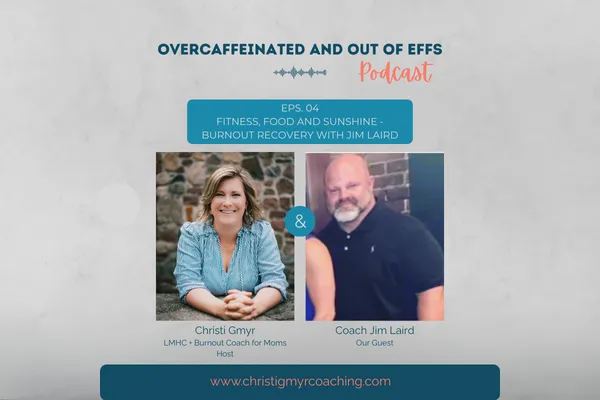
EPS. 04 Fitness, Food and Sunshine - Burnout Recovery with Coach Jim Laird - Transcript
Episode 4: Fitness, Food and Sunshine - Burnout Recovery with Coach Jim Laird - Transcript
[00:04] Christi Gmyr: Welcome to Overcaffeinated and Out of Effs, the podcast for burned out, career-minded moms who are ready to stop pretending everything's fine and feel like themselves again.
[00:15] I'm your host, Christi Gmyr, burnout coach for moms, licensed therapist and mom of two. And I'm here to help you reclaim your energy, your identity, and your peace of mind.
[00:25] Whether you're lying awake thinking about the 87 things you didn't get done or silently resenting the people you love most,
[00:32] This is your space to feel seen, supported, and not so alone.
[00:36] So grab your coffee, hot, cold or day old, and let's get into it.
[00:48] Hello everybody and welcome to Overcaffeinated and Out of Effs. This is the podcast for stressed out, emotionally exhausted, career-minded moms who are tired of pretending everything is fine and ready to feel like themselves again.
[01:04] I'm your host, Christi Gmyr. I am a licensed therapist and I'm also a burnout coach for moms.
[01:10] So today I would like to welcome our guest Coach Jim Laird.
[01:14] Jim is a seasoned strength and conditioning expert with nearly 30 years of coaching experience dedicated to empowering burned out, high achieving moms to reclaim their vitality.
[01:28] Since 1997, Jim has guided a wide range of clients from everyday mothers to professional athletes in the NFL, LPGA and mlb, as well as his team of female powerlifters, the Misfits.
[01:41] His distinctive approach, rooted in deep expertise in circadian rhythm optimization, combined with overcoming his health challenges and three years of coaching in a medical practice, sets him apart.
[01:54] Jim blends circadian biology, nutrition, exercise and stress management to help moms conquer exhaustion and thrive.
[02:02] So tune in to hear his practical science back strategies for restoring energy and balance.
[02:08] So I have so welcome Jim.
[02:12] I have invited him today because one of the goals of this podcast is to offer support to working moms in a number of different ways.
[02:20] And I'm really, really excited for him to talk about and share some strategies for fitness and nutrition that can really help these moms manage their stress and prevent burnout.
[02:31] So Jim,
[02:32] thank you so much for being here today. I really appreciate it. I'm so excited to hear about, you know, some of these things that I know you're able to offer and I was wondering if you can maybe just start off the conversation by telling us a little bit about,
[02:46] you know, who you are, anything that maybe I wasn't able to include in the bio and, you know, how you got into this work.
[02:54] Jim Laird: Thank you for having me here. I really appreciate you having me.
[02:58] It's really Interesting, because I originally started off in school as a. I played every sport. I'm originally from Canada.
[03:04] I played every sport growing up, and I went to college in the US to play college football.
[03:10] And I originally was an elementary school teacher.
[03:14] And then I actually got into the elementary school training and teaching, and I realized that the school system wasn't really set up in the best interest of children.
[03:24] It was made more to create obedient people.
[03:28] Okay.
[03:30] And,
[03:31] you know, we've taken play out of. Out of learning, and I won't get into that, but basically I was like, I don't want to be a part of this, but I still want to teach.
[03:39] So I didn't realize there was something called strength and conditioning. So I started working in the weight room at Liberty University, where I went to. Went to university,
[03:47] and I started working in the weight room. And I noticed, you know, working with football was fun,
[03:53] but I noticed I really enjoyed working with the female athletes because, one, they were underserved. Nobody really, everyone, all the other coaches only wanted to work with football and men's basketball.
[04:03] And I loved working with the ladies. They paid attention.
[04:07] They really appreciated you being there. They were much easier to coach. It was more of a mentorship,
[04:12] whereas coaching football players is more of a gorilla contest. It's like you're banging your chest, you're screaming, you're yelling. That's fun. But you do that, you know, six hours a day,
[04:22] you know, eight days, you know, eight days a week because you're. You never get a day off as a college strength coach. You. You know, So I call it eight days a week.
[04:31] It just got old. I was just like, that's just not my style. I'm more of a mentor type style. I can get in your face, but that's not usually what most women need.
[04:38] Most women need more mentorship than they need, like, you know,
[04:43] brute force, so to speak.
[04:45] And then I went to the University of Arizona,
[04:49] and I experienced the same thing there. And it was funny. I was a GA at the time, and I was getting paid $2 and 25 cents an hour.
[04:57] This is like in the late 90s.
[04:59] And I was,
[05:01] you know, struggling to make ends meet. So I got a. A job bouncing at an establishment where there's a lot of women wearing high heels, let's put it that way.
[05:10] And a couple of them were complaining. Their backs were always hurting. You know, obviously they're walking around on these. These giant heels all day. So I said, hey, come to the gym with me.
[05:18] So I started training a couple of Them, and before you know it, they're back. They're like, my back feels way better. Not only do my back feel better, I, I, I look better too.
[05:26] And before you know it, I'm walking into a gym in Tucson with like 35 women.
[05:31] And, you know, obviously that kind of gets people's attention.
[05:35] And at that time, women and strength training wasn't really a thing. And then I moved to Lexington, Kentucky,
[05:40] and most of my friends were chasing athletes, and I had some athletes that I worked with,
[05:48] but there was all these women that generally you basically get them to lift some weights, you get them eating more protein, and their bodies just dramatically change. So I basically just started training women and then the athletes I could train, I basically cherry picked.
[06:04] I basically could sit down and say,
[06:06] hey, I'm busy. You know, these ladies are very coachable.
[06:09] They're not, they don't have an off season,
[06:11] they don't have another coach.
[06:14] A lot of times you're, you know, they, they might be trying to do, you know, going to fitness classes and things that might be counterproductive, that we work on getting them out of that,
[06:21] but they never go away. Whereas my pro athletes would only be there for a couple months. And so it really allowed me to cherry pick my clients. And when you're a coach, you want to work with people who are going to be compliant and who are actually going to listen to what you have to say,
[06:38] because the last thing you want to do is be battling people,
[06:42] because that's just emotionally draining. So that's essentially how I got into working with women. In my entire career, I've worked with everybody and,
[06:50] but I generally really enjoy working with women, particularly getting them to fall in love with, with strength training.
[06:58] Christi Gmyr: Yeah, absolutely. And I mean, as you know, you know, the women that will be, that are listening to, you know, to this podcast are primarily working moms. And to your point, like, there's no off season, they're on all the time.
[07:14] It's, it's always happening.
[07:16] And you had talked a little bit earlier about how, you know, your strategies and approaches with professional athletes are going to differ with, with women, you know, with this, you know, particular population.
[07:26] And so, as you know, like, a lot of the moms who are listening to this are very overwhelmed.
[07:33] And so I'm wondering, why do you think that traditional fitness advice doesn't always work for these working moms in particular?
[07:43] Jim Laird: Well, traditional fitness is based around doing more stuff,
[07:47] and doing more is not the answer for most women.
[07:51] Women are being pulled in, you know, regardless of your Beliefs on,
[07:57] you know, gender roles and things like that. Women have more demands on them than they ever had. You know, not only if you're in the 50s and 60s,
[08:04] even 40s, 50s, 60s, even into the early mid 70s,
[08:08] if you were just a good mom, that's it. It didn't really matter,
[08:11] you know, what you looked like or,
[08:13] you know,
[08:14] you know, if you had a career, like you were a mom. And like even here in Nicaragua, like that's the number one thing. Like people really don't care about anything else other than you being a mother.
[08:24] So that's dramatically changed. So not only now do you have to be a mom, you have to be a supermodel,
[08:29] you have to be, you know, XYZ and have a career. So you're being pulled in 70 million different directions.
[08:36] And people that, you know, moms that are busy, they tend to think, well, the harder I work, the more results I'm going to get.
[08:42] And so they tend to get attracted to spinning classes, they tend to get attracted to Zumba, you know, fitness classes and things like that, which feel good at the time but end up depleting a lot of the resources that they're so desperately needing.
[08:55] Right.
[08:56] So most women are really busy and they just totally forget about their own self care. They're so busy, worried about taking care of everyone else, they don't take care of themselves and then they end up crashing and burning big time.
[09:09] You know, I have a, a lady, if you go. I have, I work with men too. I have a men's group called Vitality Brotherhood. So if you
have a husband that's struggling, you can send them my way too.
[09:18] But,
[09:21] and you can find the Vitality Sisterhood website there as well. But I have a, a little thing that says why you're not getting results. And if you click on that button,
[09:29] it'll take you to a page and it's got some testimonials. There's a girl, a lady, not a girl, a lady named Rachel who came to me, who was,
[09:35] she's a pharmacist, very smart,
[09:38] had three jobs, three children,
[09:42] and was training every day except weekends,
[09:46] and started gaining weight and her trainer told her she needed to come and do 5am class as well.
[09:51] So she was doing two classes a day and gaining weight. And finally after two years of this, she came to me and was like,
[09:58] I don't know what to do. And I have an interview with her, it's like an hour.
[10:02] And we literally go through the whole process of.
[10:05] She just thought more effort was the Key. And we went through.
[10:09] It took a while, but her before and after is just absolutely shocking. But we had to get her to understand that she needed to take care of herself. And one of the things we did right away was back her training off from twice a day, you know, five days a week to three times a week for an hour.
[10:24] And we had the support system there. She really struggled with that. She's like, how, this isn't gonna work. I'm doing less.
[10:29] What do I do in my free time? We'll play with your kids, go outside, go for a walk. Like, you know, read a book. Like something. Right.
[10:36] Um, so getting her to learn how to relax and learn how to take care of herself was a. Was a. Was a.
[10:42] Was difficult. Like,
[10:43] a lot of people think that these habits and these. These things people are using to medicate themselves are easy to change. They're not. It takes time and consistency in the fact that she.
[10:54] We talk about having other women there that had bought into the same philosophy. They all supported each other because,
[11:00] you know, you'll go through times where you're doing really well, and then all of a sudden, especially you're during a particular time of the month, you might be 5, 6 pounds heavier on the scale and feel bloated and feel like you're the size of New York State and everything's crashing down around you and you want to quit or you want to,
[11:16] you know, you want to do whatever. And it's like, it's okay. It's just this week it's going to, you know, next week the water's going to come off. Just keep at it.
[11:23] Just keep doing your walks, keep doing your stuff.
[11:26] And so having that support group is really important, but for her, like, adding more was not the answer. There's another woman on there named Suzanne who's now coaching people herself.
[11:34] She was running marathons, you know, to get the baby weight off. And the other girl, too. She was trying to get the baby weight off. That's why she started going to boot camp.
[11:42] And,
[11:43] you know, Suzanne was gaining weight and running marathons, you know, because when you do a lot of exercise, the problem is, is you can't stop eating. Right.
[11:50] And so dial. Dialing her exercise back, you know, getting her lifting weights, and she. She actually became,
[11:55] you know, nationally.
[11:57] Nationally ranked powerlifter.
[11:59] Christi Gmyr: Wow.
[11:59] Jim Laird: And. And so, you know, and. And I don't.
[12:02] I'm not trying to turn everybody into a powerlifter, but powerlifting is a really cool way.
[12:07] Combined with some athleticism. Combined with some athleticism that Most women really enjoy getting stronger, you know, particularly deadlifts. They really like that. It makes them feel powerful.
[12:18] Go ahead.
[12:18] Christi Gmyr: Well, and. And to your point, I mean, going back to what you had said, you know, a few minutes ago, like, yes, like, so many women, so many moms, working moms, you know, they do.
[12:28] They feel this pressure to be,
[12:30] you know, to be perfect in everything, to be able to do all the things and to do all the things really well,
[12:36] you know, and when you were talking about, like, maybe the mindset of the only way they can be successful is if they're working harder, and you were finding, or they were finding that it really wasn't working for them.
[12:46] And so it sounds like,
[12:48] you know, if I'm understanding right, that this pressure on them to do it all and bounce back after having kids, you know, you are able to help them,
[12:57] you know, let go of some of that pressure by kind of talking to them about it, normalizing it, you know, and sort of just really letting them know what. Like why that doesn't work and what other things would maybe work better.
[13:09] Did I understand all that right?
[13:11] Jim Laird: Yeah, of course. Getting them to learn how to work with their body instead of trying to push it, you know?
[13:16] Christi Gmyr: Yeah, yeah.
[13:17] Jim Laird: When you work, it's like. It's like dancing with someone. Like, sure, I can pick you up. Like, I'm. I'm a. I'm. I'm like five, nine, five ten. I'm 245 pounds. I was, you know, one of the stronger guys in the world for a long time.
[13:30] And I, you know, sure, I can pick you up and. And move you and. And force you to move in certain ways, but it's much easier if we. If we dance together.
[13:37] You know, somebody's got to lead, but. So the body's the same way. If you work with the body,
[13:42] you'd be shocked at how much easier the results will be. Instead of trying to force, you know, putting a gun to your body and saying, you better do this. You better lose weight, or else the body.
[13:51] The body doesn't do well in a constant state of survival. So.
[13:55] Christi Gmyr: Right.
[13:56] Jim Laird: Once you learn how to work with the body, you'll get. You'll get much better results.
[14:01] Christi Gmyr: Okay,
[14:02] so now when we're talking about, you know, stress in particular and recovery from burnout, you know, you've been talking a lot about,
[14:10] you know, strength training with women in general. But I'm curious, like, what. What role do you find or do you believe that strength training does play in helping moms to.
[14:20] To manage those things?
[14:22] Jim Laird: Well, a strength training is gonna do a much better job at balancing hormones than something like, I'm talking about traditional, like lifting weights as opposed to like metcons and like crossfit or Orange Theory.
[14:34] That stuff just steals cortisol. And most women are already cortisol monsters they don't need anymore.
[14:41] So strength training will help reduce, help balance hormones and help regulate cortisol if it's done properly. The biggest thing is getting outside.
[14:50] You know, you have to get outside, particularly in the morning,
[14:53] getting the circadian rhythm, getting a nice protein rich breakfast.
[14:57] Women do not do well with fasting. I, I women, I find most of the women that come to me have either done a lot of spinning, group classes,
[15:08] high intensity stuff, and they've intermittent fasted and it worked maybe for a little while, or they've done keto and they just, it doesn't work anymore because you have somebody who's already under a lot of stress.
[15:18] The thing about fasting and keto is it relies highly on cortisol as a mechanism for blood sugar regulation.
[15:25] And if you're already a cortisol junkie,
[15:28] pushing that cortisol pathway even more. Whereas carbohydrates, everyone thinks they're the enemy,
[15:32] but they actually hydrate you carbohydrate and they actually help regulate cortisol.
[15:38] But as far as the stress management compos component, the walking my number, I have five fundamental habits. And the number one habit is walk outside three times a day, not for exercise,
[15:49] but as an observation. So we put the tongue in the roof of the mouth, we close our mouth, we breathe through the nose, we look at the birds, we get out of nature,
[15:57] we calm ourselves down,
[15:58] we relax. And that's. Most women are just going all the time. They're on their phone, they're running their kids everywhere. So if we could slow things down and we can shut it down and allow the body to go into rest and digest.
[16:10] So you actually start digesting your food and it's really cool. These AI tools are really scary.
[16:15] But if you type in like circadian rhythm and cancer, circadian rhythm and blood sugar, circadian rhythm and digestion.
[16:23] Circadian rhythm, like circadian, like the sun runs everything from your digestion to your, your hormones.
[16:30] Like most people don't understand, the morning sun sets your hormones for the whole day.
[16:35] How many people don't go outside at all? And then it's like if you have children, it's a great way to get them out on a walk with you or in the stroller,
[16:42] getting them into the Habit of getting outside because we live an indoor sedentary lifestyle now. So you're setting a great example for your kids.
[16:50] Excuse me,
[16:52] by getting outside and getting them used to being outside and being active and just getting in. Nature calms people down.
[16:59] That's the biggie. That's really the foundation, I think, of, you know, regular movement throughout the day,
[17:06] resetting that circadian rhythm,
[17:08] even movement. If you don't move,
[17:10] you're gonna have more digestive issues. Digestion,
[17:14] excuse me, is so reliant on movement and blood flow.
[17:19] And most people don't understand that. If you type in sunlight, circadian rhythm, circadian disruption,
[17:25] type in, like, what are the effects of sedentary indoor lifestyle on digestion into. Or hormones into ChatGPT. You'll be shocked at the answer you'll get.
[17:35] Christi Gmyr: Well,
and it's really interesting to me listening to you talk about this too, because, you know, one of the reasons is because,
[17:41] you know, obviously all the moms, you know, everybody is from all over.
[17:47] I live in Central New York, and so we have a lot of time inside, right, because of the winter. We have long winters, and it can be. Right now we're in the middle of summer, and our.
[17:57] We're 90 degrees. So when, you know, people are staying inside again.
[18:01] But I'm just curious, you know, how do you sort of manage that with people who. You're saying that they should get outside three times a day?
[18:08] You know, but for whatever reason, maybe it's. It's just really hard for them. Do you have any ideas around that?
[18:14] Jim Laird: Well, we just do the best we can. We start with the morning. That's the most critical. The morning and the evenings are the most important.
[18:20] Christi Gmyr: Okay.
[18:20] Jim Laird: We start where you are, and it's a matter of how. Like, how much. How much have you suffered? How much you're willing to change? And people have, like. For me,
[18:28] I ended up having ulcerative colitis, and I used stress management, dietary changes, and that's from me working too much. And I had a lot of trauma that I hadn't dealt with, and I had a lot of anger that I was using training and then working hard to manage.
[18:43] And I Once I learned how to forgive some people and put that behind me, I didn't have to train like a maniac anymore and work so many hours. I was able to get in a better place.
[18:52] That's where I learned about the stress management component of autoimmune disease and all that stuff from colitis. But several years later,
[18:59] I ended up getting a staph infection from a pedicure.
[19:02] A young lady was like, I don't like your feet.
[19:05] We're canceling all interaction physically until your feet get in a better place. I was just like, you know, because I'm a coach, I'm like, all my feet, they're sweaty. You know, it's just strength coaches and feet, it's just not.
[19:18] Or athletes and feet, it's just not a. You know. So I went and got a pedicure.
[19:22] I almost had my right leg amputated from it.
[19:24] I got a staph infection from it. So then I learned from that experience. I dove into the and talked to some different people.
[19:31] I was working from 5 in the morning till 8 at night in a gym.
[19:36] And so luckily they didn't have to amputate my leg. They were able to basically control it through antibiotics.
[19:41] And they said, well, here's the kicker, this is gonna come back.
[19:45] And it's gonna come back as like full body sepsis kind of infections.
[19:49] And sure enough, it started to. And so they gimme antibiotics and you know, four, five, six treatments.
[19:57] All of a sudden this infection is becoming antibiotic resistant.
[20:02] And I started researching and I'm like, oh, the sun runs your immune system, the sun runs your digestion.
[20:07] Oh, wow, I really need to get outside. So I, I did a complete 180 and I literally didn't start my day until 10 and I spent my whole morning outside.
[20:16] And I, I was such an indoor creature.
[20:18] If I went out in the sun, my eyes would water, I'd wear sunglasses.
[20:22] Um, and so I completely redesigned my life.
[20:25] I would, I would, I got some red light panels in the gym, I would keep the doors open more often.
[20:30] And then my, I got used to being outside and now my, it's the opposite. When I go into like a Walmart or I live in Nicaragua, they do have a Walmart here.
[20:38] But if I go into, into Walmart, my eyes hurt from the fake lights.
[20:43] So,
[20:44] you know, a lot of people, it's like, how much suffering have you been through is how much you're willing to change. But I've had plenty of women just do like three 10 minute walks and that was enough to get them going in the right direction.
[20:56] So it all depends. I'm, I just start where, when people start where they are,
[21:00] if it's sitting outside for five minutes and they're like, wow, I feel so much better, I'm sleeping so much better.
[21:05] And then they start to want to do more. And then it's a matter of figuring out like, okay,
[21:09] you don't need to move the equator like I did to move to Nicaragua. You don't have to live in a rainforest like I chosen to do.
[21:16] But you're not getting any time outside. So 10, 10 minutes, three times a day is going to be better. And then you figure out what the right amount for you is.
[21:25] And, you know, there's ways of like,
[21:27] mitigating a lot of the artificial light inside. You know, you can, you could crack a window. You can, you can buy a red light panel and put it on in the background that, that, you know.
[21:35] Cause the, the, the lights indoors are only blue.
[21:38] And blue by itself doesn't occur in nature. And blue is the cortisol spiker. In the morning, it spikes your cortisol. But sunlight has blue, red, all these different colors that all send your brain a different message.
[21:49] What hormones to produce, what time of day it is.
[21:53] All your organs, your, your gut microbiome is actually affected by sunlight. It's crazy.
[21:57] Um,
[21:59] so when you're inside being blasted by this light that's only been around for really 30, I think LEDs and fluorescents have not been around that long.
[22:09] We're, we're living our entire life, life under a form of light that our biology's never seen,
[22:16] ever.
[22:17] Right? They used to have incandescent. Incandescents and incandescents at least had red in it, and red balances out blue.
[22:25] But the incandescents are, are bad,
[22:27] quote, unquote.
[22:28] So they don't allow them anymore.
[22:30] So, you know, it's just a matter of like, okay, how much do you want to start with? You know, like,
[22:35] you know, same. Like protein is one of the big things I tell women to do. Eat a protein at every meal.
[22:40] Some women have never really eaten much protein at all. So maybe we add like two slices of turkey with every meal, you know,
[22:48] McDonald's.
[22:49] Christi Gmyr: So what I'm hearing you say though is like, so getting outside is obviously really important. You know, you're talking about, you know, three times a, three times a week, morning, evenings,
[22:57] and you even mentioned like five minutes. So which was going to be one of my questions is like, is there a minimum amount of time? But it sounds like really whatever works for each person.
[23:07] Jim Laird: Well,
[23:08] here's the deal. Like, we're design, like in the, I would say in the 70s,
[23:12] people spent about 50% of their time outside.
[23:17] Now it's like people spend 90% of their time indoors.
[23:23] So it's like the more,
[23:25] the more natural light you get, the better the le. Even if it's like if it's super hot, just go sit up. Like, I'm, I do all my work on my patio.
[23:33] I'm outside right now, you know, you,
[23:35] you can't see, but I'm in Nicaragua, I'm on my patio, I do all my work so I can take a break for my eyes. And I can look off in the jungle and stare at that monkey that's looking at me right over there on that tree.
[23:46] Right.
[23:47] So it's just, it's like, you know,
[23:50] your body requires certain things and sunlight is one of them. And so is human connection.
[23:56] And the question is, is like every, there's obviously too much. And it's just like, my dogs know, you'll see my dogs, they'll go out in the sun,
[24:05] they'll lay in the sun for a short period of time,
[24:08] and then they'll go in the shade when they've had enough.
[24:11] And we are not getting maximum security prisoners get more time outdoors than children do today.
[24:18] Christi Gmyr: Wow.
[24:18] Jim Laird: So it's like, you know,
[24:20] we have certain essential needs and we are dramatically under those. So I just tell people, start where you are, do what you can.
[24:29] And most people, as they realize how much better they feel when they get outdoors, they start doing it, even if it's uncomfortable.
[24:37] Because our biology is incredible. Like,
[24:39] we are so adaptable.
[24:41] And even you might think it's hot now, but you start in the mornings, you start in the afternoons and you're like,
[24:46] you know, after a few weeks of that, and then you sit outside in the shade at, at, at noon or 11:30 and you're like, this isn't that bad. I'm gonna start with a three or four minute walk and I've got some trees on my route, so it's gonna be shaded,
[24:58] and then you just go. It's just like a cold. Like, you know, once you've exposed yourself to cold,
[25:04] all of a sudden it's not a big deal, it's not as bad anymore, right. So you just wanna slowly expose yourself to these things. And I wish there was a magic number.
[25:13] Um, but your vitamin D levels are a good, a good indicator. You know, if you're below 25, then you definitely need to get outside more.
[25:19] But, you know, your sleep is another indicator as well. Like if you're not sleeping well, you're probably not getting outside enough. But I, I try to live, I try to be the opposite.
[25:30] I try to have zero fake light and as much natural light as I possibly can.
[25:36] The only time I'm really inside is when I sleep. And, and then I have a.
[25:40] I have a red light panel on in the background that I use, so I don't have to turn the overhead lights on and off. But that's me. And that. That's what I've decided to do.
[25:50] But. But, you know, it. It's better to be. It's. You know, you need to at least move away from being indoors 10% of the time. And then you think about it, when you do go outside, are you actually getting skin in the game or are you just sitting in your car with the windows rolled up?
[26:04] You know,
[26:04]
so.
[26:05] Christi Gmyr: Mm.
[26:06] Yeah,
[26:07] that's basically the. Yeah, yeah. No, that. That makes sense.
[26:11] So I wanted to come back to, you know, something that you. You were talking a little bit earlier. You had started to touch a little bit on nutrition, and then we kind of moved away from that.
[26:20] But I did want to come back to that because I do know that that's also something that so many people struggle with.
[26:25] And again, when we're talking about,
[26:27] you know, you were talking about how maybe fasting isn't very good for them. And I feel like working moms in general, a lot of times, they really do struggle with getting proper nutrition.
[26:37] Sometimes it could be that they are eating too little. Maybe they don't have time. Maybe they're just grabbing snacks so they can throughout the day instead of real meals. Also, on the flip side, maybe they're stress eating, you know, at night or whatever.
[26:48] And so I was wondering if you could speak to that a little bit in terms of, like, how,
[26:52] you know, their nutrition, how our nutrition does impact,
[26:56] you know, energy and stress levels. And then any ideas or things to keep in mind that could help with that?
[27:04] Jim Laird: Well, you gotta understand that anytime you go unfueled under a lot of stress, it's gonna put your body under more stress.
[27:12] Women, biologically,
[27:13] evolutionarily, whatever you believe,
[27:16] whether we were put here or was a giant explosion,
[27:19] is regardless that we're designed, women are designed to be more nurturers. They're not designed to be warriors. Okay.
[27:25] That doesn't mean a woman can't be a warrior,
[27:27] but it's kind of like a Corvette versus a 4Runner.
[27:30] Like, can a Corvette go off road?
[27:33] Sure, but it's not going to be very good.
[27:35] Can a 4Runner go on a indie Indianapolis track and race? Yes, but it's not going to win.
[27:44] So the 4Runner is much better at going on, like, country roads and on. On dirt, and the Corvette's much better on being on the track.
[27:51] Women are much better at being nurturing and and, and being in that kind of environment, men are set up hormonally to handle more stress and to handle high stress situations.
[28:00] They just, our hormone, our hormonal systems are much simpler and we can survive more extreme environments. That's just the way it is. I, you know, hang me upside down, burn me upside down if you want to,
[28:12] but that's just the way it is. You gotta understand that as a woman that you're not designed to handle these extremes.
[28:19] Your body's just, you can,
[28:21] I mean, our bodies are extremely resilient, but eventually if you push the body in that manner, it's gonna fight you.
[28:29] So nurturing and then a protein at every meal is, is essential.
[28:35] Then most women need a moderate bit of carbs. But sitting down, actually chewing your food, I know it's really hard with kids and stuff,
[28:41] but getting your meals prepped ahead of time so that you're not running around with a chicken with your head cut off,
[28:47] slowing down and actually teaching your children too, to sit down with you. And if you've got 14, 15, 16 year old kids,
[28:55] for the love of God, why aren't they making the meals? Why aren't they cooking for themselves? Like, yeah,
[29:00] so AI is about to take over the world.
[29:04] Your kids should know how to cook, they should know how to clean, they should know how to do things.
[29:08] So you have these children, you need to put them to work in your house, you need to mentor them and teach them these skills.
[29:14] How many kids today even know how to cook their own food? Right? So these are things that you need to step up and say, hey babe, like honey, or whatever you call your kids, like,
[29:24] you need to help mommy. You know, you're old enough now to do this stuff. Let's, let me show you how to scramble some eggs.
[29:30] Let's, let's make a meal for the family together. Let's take Sunday. Everybody works together.
[29:34] We do meal prep.
[29:36] So that's a, that's a big part of it as well.
[29:39] So the stress monster, you know, the more stress you're under,
[29:42] the more you're gonna wanna eat. And then also back to the circadian stuff.
[29:45] So guess what regulates appetite regulation,
[29:48] sleep and circadian rhythm. If your circadian rhythm is broken and you're sleep deprived, you're not gonna have as good of,
[29:56] you're not gonna make as good a choices and you're not gonna be able to shut your appetite off. That's why everybody needs a GLP today because their circadian rhythm is broken and they're sleep deprived,
[30:04] right? And of course, you know, as a therapist, when you're sleep deprived, it's almost like being intoxicated. When you're intoxicated, you don't make good choices.
[30:11] So you fall into this stress loop of no sleep,
[30:14] you know, then more caffeine. And then I go to spinning class and I'm going to hammer that cortisol pathway because, Lord, it makes me feel good for 45 minutes. And then I'm done with spinning class and then I'm going to go with my friends and I'm going to drink a giant cappuccino latte with caffeine.
[30:29] I'm going to bump my cortisol even more.
[30:31] I'm going to just completely deprive my body of hormones and hammer that stress pathway. Then I'm going to eat a whole piece of cheesecake and then I'm gonna feel terrible for two days and I'm not gonna sleep.
[30:41] And it's just this, you know, constant. Then it's like, oh, I need a pre workout, oh, I need a supplement, I need an energy supplement. You know, it's just this pit that, that, that people fall into and they, they can't, they can't get out of it.
[30:52] And the number one way to stop that is to stop. Like, it's like being in quicksand and you're struggling is to stop, right? And then to take a step back and then focus on, you know, the five fundamentals, which is walk outside three times a day for 10 minutes,
[31:06] get a protein at every meal, get the lights off at night, drink high quality water, preferably spring water,
[31:12] and have good social connection. And I know being a busy mom, that's really hard to do. And if you listen to the interview with Rachel,
[31:19] we talk about how she, you know, instead of working out like five, six days a week,
[31:24] she was only working out three times a week for an hour.
[31:27] So she had more time to spend with her family, she had more time to prep food. You know, maybe you need to hire a meal prep service.
[31:34] You know, you've got to put the oxygen mask on yourself first.
[31:38] The plane's going down. You put the oxygen mask on yourself first. And then you help your children.
[31:43] So you need to prioritize your own self care so you can be there for your spouse, you can be there for your children.
[31:49] That, that's basically the message that I, you know, constantly am beating into women's heads.
[31:54] Christi Gmyr: Yeah. And I, and I really like, you know, a lot of these things that you're saying are very similar things that I also Talk about a lot in terms of,
[32:02] you know, taking care of yourself first and, you know, prioritizing yourself. And, you know, you talked about life skills for kids and how it could be a benefit in that sense too.
[32:10] You know, not only is it helping you to get some of these things done, but it's also valuable to them because it's helping them learn these important things,
[32:17] you know, and you're talking about a lot of like, really useful strategies, you know, that I know they're gonna find these moms are gonna find really helpful.
[32:25] One of the things that I also talk about a lot is I really talk a lot about the importance of mindset. Right. Because you can do these practical strategies, you can have these tools, but if your mindset is struggling, you know, you're still going to have a hard time with some of these things.
[32:44] And so I'm curious to hear your thoughts on, you know, what mindset shifts do you find most helpful for these burned out moms who do want to get stronger and feel better.
[32:56] Jim Laird: So you got a big pile of dirt in your front yard. It's massive, it's 20ft tall.
[33:01] Instead of focusing on the big pile of dirt, you focus on what you can do that day.
[33:06] Some days it's going to be two shovelfuls of dirt.
[33:09] Other days it's going to be a teaspoon.
[33:12] And so you just do what you can do on that day. Some days you're going to go to the gym, you're going to feel good, you're going to challenge yourself.
[33:17] I always tell people to leave a little in the tank, walk away while you feel good.
[33:21] Some days you're gonna feel like garbage. And we're gonna do a little warmup and just get you moving to make you feel better.
[33:27] Some days you're gonna feel amazing. Some days you're gonna feel like garbage.
[33:31] Christi Gmyr: So not focusing on the big thing. Cause that can be very overwhelming for a lot of people.
[33:36] Jim Laird: Focus on that.
[33:36] Christi Gmyr: Breaking it up. Yeah.
[33:38] Jim Laird: Focus on the process,
[33:40] don't focus on the outcome.
[33:42] And then understanding that you're gonna have good days, you're gonna have bad days, and you just, you just feel, you just do what you can do. But every day you move some dirt, whether it's two, two, you know, a whole front end loader one day and one teaspoon the next day.
[33:56] Every day you're moving dirt and you get up and you do what you're supposed to do. And some days you need to. I use this, this. You can't see it, but it's Aura ring.
[34:06] I was working with a lady. A lot of people that are highly driven and they're so addicted to cortisol and they're so addicted to stress.
[34:13] They don't. It comes
normal to them. They don't. They don't feel stressed, even though they're extremely stressed.
[34:19] And I like things like the OURA ring because it'll tell me your hrv, it'll tell me your resting heart rate, it'll tell me your respiratory rate, it'll tell me how much stress you've been under during the day and how much restorative time you're getting.
[34:31] And I worked with this high level lady executive CEO. She's seen, like every big influencer. This woman had a lot of money.
[34:39] Every influencer you see on social media, she saw.
[34:43] Christi Gmyr: Mm.
[34:44] Jim Laird: And they did every blood test,
[34:47] every genetic. Every thing. And they're like, well, there's nothing really. She's like, I'm so tired all the time. I don't know why.
[34:54] And they're like, well, it's this take, this supplement take. And it never worked for her. I looked at her aura ring data.
[35:00] We went back six months.
[35:03] She didn't have one minute of restorative time during the day. Not one.
[35:08] Christi Gmyr: Wow.
[35:10] Jim Laird: Not one. Her HRV was like five.
[35:12] An average woman's HRV should be like 50 to 80.
[35:15] Hers was five.
[35:17] As I said, we're gonna work on learning how to chill. And sure enough, she put some. She started with one. She got one minute finally, of restorative time,
[35:27] and then it went to two, and then it went to five. After weeks, right. Of looking and she was. She could see it. And people like that need to see the data.
[35:36] And then all of a sudden, she started getting more deep sleep. And all of a sudden everything started to improve. As we went outside more,
[35:42] we started working on.
[35:43] We. I call it working in. You got to work in so you can work out. You can't constantly keep charging your credit card. You're not the government. Right?
[35:51] You gotta pay it off eventually. Eventually you gotta pay the credit card off or the interest just gets overwhelming.
[35:57] So months go by. She's doing really, really good. And then I get a phone call. I don't understand what's going on.
[36:02] I'm not doing so well anymore. Let's look at your data. Oh. You went from 30 minutes of restorative time a day to zero again. What's going on? Well,
[36:10] we had a death in the family and just got stressed, started having a couple of glasses of wine and just got busy and Got overwhelmed with work and just totally have ignored my self care right back where she was started.
[36:24] So we had to say, look, you got to go back to the ba. This is something that never ends.
[36:28] And I have probably 30 or 40 clients I worked with over a 20 year period in Lexington. And that's basically what my job was, is like get back on the road, stay on the road.
[36:38] Because human nature is basically to,
[36:44] there's, there's two sides of it to do as little as possible,
[36:48] right. Because we're designed like we traditionally we would have to do a lot of work to eat,
[36:54] right. So we'd have to do lots of manual labor. So we're wired to eat as much as possible because there was not a lot of food and we're assigned to move as little as possible.
[37:01] And then women basically hung out, raised the kids and there was a lot of interaction socially. And then obviously women don't have the physical capacity to like conquer people.
[37:11] So they would use like, you know, social interaction to like build leverage and power.
[37:15] And so there's a lot of interaction there.
[37:18] And so it's kind of one of those things where we get caught up in this loop of just spinning and spinning and spinning and spinning and not being able to shut it off and not being able to relax.
[37:33] Because our modern world has taken silence away. Whereas you know,
[37:37] even, even 1970, there's only three channels on the TV.
[37:41] You weren't up watching Netflix till 2 o' clock in the morning and you, you actually had quiet time and silent time.
[37:49] Now you're in the car, you're on the phone, you're always going.
[37:53] And so I compare it to getting in your car and revving it all day with never driving anywhere. And that is very. Your body doesn't know the difference between you running in your head and running for real in real life.
[38:03] And so getting women to step back and, and, and center themselves. Like I tell women all the time, like look, if you start racing in your head, just put the tongue in the roof of your mouth, slow your breathing down and then watch your thoughts, right?
[38:17] Watch em instead of engaging with them. So you're not spinning. But this, this lady,
[38:22] she had spent all this money and the reason she was struggling is because she was just never stopping, she was never resting, she was always going.
[38:32] And it wasn't physical going, it was emotional. And in her head.
[38:35] Christi Gmyr: Yeah,
[38:37] yeah,
[38:38] well, yeah. And I, and I hear what you're saying and I think all of that is, you know, that's all really helpful. And you were also Talking a little bit before about,
[38:45] you know, focusing on the process, you know, a little bit at a time, all of that, you know, instead of the outcome for a person though, who is,
[38:54] you know, completely overwhelmed and they're wanting to do these things that you're talking about because there are several things, right? We're talking about exercise, we're talking about nutrition, we're talking about mindset, we're talking about getting out in the sunshine, all of those kinds of things.
[39:08] So if somebody was really exhausted and overwhelmed,
[39:12] where would you suggest they start? Like, what would be a good starting point for them?
[39:18] Jim Laird: Well, it depends on the person, how if they're orthopedically damaged or not. But getting outside three times a day, at the very minimum.
[39:24] Okay, the first, the first thing to do when you're completely overwhelmed is quit digging the hole,
[39:29] right? So stop digging the hole.
[39:32] And the first thing I would do if somebody's in really bad shape, I would just go sit on your patio for five minutes,
[39:37] close your eyes, put the tongue in the roof of your mouth and just work on slowing your breathing down. Cuz people that are overwhelmed, they're trapped, their necks are gonna be breathing with their neck and traps and there's specific drills we can do things like crocodile breathing that can help with that.
[39:50] Um,
[39:51] but the getting outside part, because guess what,
[39:55] when you get outside is say if you can go for a five minute walk, right,
[39:59] you're fixing your circadian rhythm, okay, which improves your sleep,
[40:04] you're helping with hormone production, you're helping with digestion, you're helping control blood sugar, you're lowering stress, right, by getting outside in nature, just looking at pictures of nature, lower stress,
[40:16] improving hormone function, improving digestion,
[40:19] all those things just by going outside.
[40:21] So you're checking off a million boxes. So that's where I would with most people that are broken,
[40:26] I'm just like, just go outside,
[40:28] put on some binaural beats, put on some Enya,
[40:31] just sit there and breathe. Breathe through the nose, slow your breathing down and start with that.
[40:35] And then we do that for a week and then we just add something else. Add something else.
[40:40] And then we build the base we want to build. So my base level of my pyramid, so we have this fitness or I call it wellness pyramid.
[40:49] My base level of pyramid is built on walking outside three times a day for 10 minutes. The protein @ every meal,
[40:55] the high quality water to get the lights off at night, and social connection,
[41:00] that's my base of my pyramid. Moderate exercise is on top of that.
[41:05] Intensity is on top of that.
[41:08] Right. So if people want to live a long time and look good and feel good, they need to flirt with performance, not marry it.
[41:16] Everything else at the bottom of the pyramid is to support the stuff at the top of the pyramid.
[41:22] Christi Gmyr: Mm.
[41:23] Jim Laird: Most people's pyramid is. Is horrible. They don't have a good pyramid. They're trying to build their pyramid on tools. Hrt, peptide, these things can all be useful.
[41:33] Fancy diets, fancy training programs, these things. People are building their foundation on tools.
[41:39] We want to build our foundation on fundamentals,
[41:41] and then we want to put the tools on top of the fundamentals so the tools will actually work.
[41:47] And then when you run out of therapeutic Runway from the tool because the supplement or whatever you're doing stops working,
[41:54] everything doesn't fall apart because you haven't built your foundation on tools.
[41:58] Christi Gmyr: Right,
[41:58] right. Yeah, yeah. No, that makes sense. And so again, so like, with all. It sounds like with all of these things, you know, starting a couple minutes outside a couple times a week,
[42:08] start there. And then to your point, well, I.
[42:11] Jim Laird: Would say daily, you need, you need to get outside every day.
[42:13] Christi Gmyr: Okay.
[42:14] Jim Laird: That's one of those non negotiables that like, a couple times a week,
[42:18] your circadian really, like, if you're gonna do anything, get outside first thing in the morning. If you can crack your window while you're driving to work,
[42:25] great. You do get. You do the best you can. But, but I think getting outside in the morning, that's. That really sets the tone for everything.
[42:34] And so, and that's what I do essentially is like, okay, where do we start? Like, most. The biggest mistake I see is people, they're like, in Tampa and they want to go to Alaska and they think, I could start in St.
[42:45] Louis or Denver.
Like, it just. You can't do that.
[42:48] Most people try to start way more advanced than they are.
[42:54] And so my job is to basically, like, assess where you're at and then figure out, like, what, like, you know,
[43:00] maybe your goal is to lose body fat, right? And you're doing all these. These hit classes and stuff, but, you know, you're on. You're on birth control or you're on an antidepressant, or you're on something that's causing you to actually gain weight or you have no gallbladder, right?
[43:17] And that's causing a lot of digestive issues, which leads to overeating. And so we add some. We change your diet a little bit, we give you some digestive support,
[43:25] and then all of a sudden, oh, wow, I feel better. I just, I'M suggesting my food better, my body's getting healthier, and you start losing weight or, you know, I'm on depo.
[43:34] Oh, my gosh. I stopped taking depo and I dropped 10% body fat in like a month. I've had it happen.
[43:40] So it's like, are you on a medication that's keeping you from, you know, changing your body composition?
[43:46] You know, are, you know, so it's just an investigation process. It's asking a lot of questions.
[43:51] That's why my job is so much fun. As I'm like. I'm like Sherlock Holmes. It's like, okay,
[43:56] let's. Let's start with the base foundation of the pyramid.
[44:00] And then, okay, you're struggling with this. Oh, you can't relax. Like, do you have a deviated septum?
[44:05] Can you breathe through your nose?
[44:07] Are you. Is your body stuck in a strategy that leads to over breathing? Oh, okay. Can we change that strategy so you breathe better? And that's. That's where getting to know you really comes into.
[44:16] Into play. And that's where, if you come into my community, the Vitality Sisterhood, we can get to know you. We can ask questions,
[44:23] we can kind of reverse engineer things and then add these fundamentals in.
[44:28] And then all of a sudden it's like, oh, things are getting way better. We need to tweak this or we need to do this, or, you know, is the workout giving you the outcome that you want?
[44:36] Christi Gmyr: Like, you know, all very individualized.
[44:40] Jim Laird: The principles are all the same for everyone. The application's a little bit different, right?
[44:44] Christi Gmyr: Yeah, yeah, no, absolutely.
[44:46] So then anybody, you know, for all the people who are listening today, if they wanted to hear more about this, if they wanted to learn more about this or learn more about you and your work,
[44:55] where could they go to do that?
[44:57] Jim Laird: Vitalitysisterhood.com that'll take you to my school group. It's completely free.
[45:02] You can join that. There's all sorts of people posting there every single day.
[45:07] And then my Instagram is probably where I'm the most active. G Y M L A I R D. I named my gym after myself, Jim Laird. Don't ever do. Don't name your business after yourself.
[45:17] It doesn't end well when you go to sell it. So my Instagram handle is G Y M L A R D. I post all sorts of stuff about circadian rhythm,
[45:24] all that kind of stuff. But come into the Vitality Sisterhood, I gotta do two calls a month and just ask questions. I have some coaching services as well. I have Some.
[45:36] Some individual and some group coaching stuff that I do as well. But really, the compliance. I'm going to steal a term from my friend Stan. Effort and compliance is a science,
[45:46] and most people are just not doing the basic fundamentals,
[45:49] and they're looking for shiny objects. And,
[45:52] you know, shiny objects may work for a while, but the wonderful thing about selling shiny objects is when that object quits working, then you have another shiny object to sell.
[46:01] Not that I'm against using tools or tricks. They have their place. But you can't build your foundation on tools. Like,
[46:09] you know, you can't build the foundation of your house on chandeliers and curtain rods and drapes.
[46:14] The foundation of your health house has to be cement and walls and frame shingles. You can't build your. I mean, you could build your house out of shingles, but it wouldn't work very well.
[46:24] Most people are.
[46:25] I did an analogy the other day on Instagram where you're the captain of the ship, and all of a sudden it's like the ship, you know, shimmies, and you hit something.
[46:32] You hit an iceberg.
[46:34] And the captain.
[46:35] The captain sends his engineer below deck and says, what? What happened? Give me a damage report. The engineer comes back up 45 minutes later and says, you know, captain, we hit an iceberg.
[46:44] We've got water coming into the boat, so I'm sending the whole crew upstairs. We've got some rust on the upper deck, and we're going to sandblast it and repaint the.
[46:52] The upper deck, and we're going to move the deck furniture around. And the captain's like, what do you mean? Like, we got water coming in the boat? No, no, that's the most important thing, and that's what most people are chasing.
[47:00] Most people are chasing these things that are trendy,
[47:03] fancy diets, supplements, that sort of thing. When they have these gaping holes in their fundamentals that are that. I don't think I've ever had someone come to me where more was the answer.
[47:15] Usually it was like, take a step back, reassess. And that doesn't mean we can't advance,
[47:20] but it's like, reassess, build a foundation. And then all of a sudden, we have a foundation to,
[47:25] you know, flirt with performance a little bit. If we want to, you know, add some muscle mass, or we want to get stronger or we want to, you know, we want to play pickleball or tennis or whatever it is that we want to do.
[47:34] But you have to come back and build that base, fundamental base of habits.
[47:39] So that you, you have the ability to then build on top of that. And most people don't have that base.
[47:44] If you go back and look at the 70s, most people spent way more time outside.
[47:48] They cooked a lot of their own food,
[47:50] people were more active. They, they, they went out, they went out with friends. They, they, they did stuff as a community.
[47:56] And that's why you don't see the massive obesity rates in the seventies that you do now. Because people live an indoor sedentary lifestyle.
[48:04] They're, you know, up at 2 o' clock in the morning watching Netflix and they just can't stop eating processed food because their circadian rhythm is broken.
[48:12] And then they're trying to make up for a sedentary lifestyle with intense exercise and it just doesn't work.
[48:18] Christi Gmyr: Yeah, yeah, no, that makes sense.
[48:20] So, I mean, and so all of these things, you know, you had talked about,
[48:24] you know, your website, your Instagram, you know, these different things, all of that's going to be available for everybody in the show notes, you know, so they can find you.
[48:33] If you could, you know, leave everybody with one final message before we kind of wrap up for today. What do you think that would be?
[48:42] Jim Laird: Be still. And know silence is the most important skill you can build. I think silence,
[48:50] if you look at,
[48:52] you know, I'm not ultra religious, but if you look at Jesus, Muhammad, you know, every major religious figure, they all went off into the wilderness, they all went off into solitude, they all went off into silence.
[49:03] We have robbed our society from silence today.
[49:07] Always on your phone, always scrolling, always doing something.
[49:11] Learn how to go off in a corner somewhere, whether it's on a park bench,
[49:16] close your eyes, take a couple breaths and just listen to the birds.
[49:21] Clear your mind for two or three minutes and just sit,
[49:24] let your hard drive reboot.
[49:27] I think silence is when our hard drive reboots itself.
[49:30] And I think that that's one of the main reasons so many people are struggling today because they never take that time to slow down and become present and live in the moment.
[49:39] So be still and know.
[49:41] I think not only like, cherish, enjoy that silence.
[49:48] Even if you have to go into the bathroom and just sit there for three minutes and be like,
[49:52] take a breath and sigh and be like, ah,
[49:56] silence. Just a couple minutes. Especially as a new mom, like most people,
[49:59] you know, cherish those, cherish those silent moments.
[50:03] Christi Gmyr: Yeah, absolutely. I couldn't agree more. And to your point, like, we live in such a,
[50:07] like a noisy world. I mean, I, I will tell you, you know, several years ago, I don't even know. Probably at least a decade ago, I was noticing that myself.
[50:16] And I made this change. I was going to temporarily test out. You know, driving in the car with my radio turned off.
[50:22] Never went back. 99% of the time I drive in my car with my radio off.
[50:26] You know, I like to spend time sometimes just sitting out in the evening after my kids go to bed, sitting outside. We have a pond outside. I like to listen to it, you know, because.
[50:36] So, yeah, I feel like silence is. And I even just discovered not that long ago, maybe two weeks ago, that I actually prefer walking without my music on, which I used to do all the time.
[50:47] Jim Laird: So I tell people all the time to go for your walk. Leave your phone. You might want to take your phone with you because in case of an emergency. Yeah, but like, it should be, like, you know, in airplane mode or, like, by your side.
[50:58] And plus, you don't want to have headphones on when you're walking.
[51:01] You want to be able to hear things and be aware of what, like, so many women are, like, glued to their phone while they're walking down the street. Like, that's just a
giant sign that says attack me.
[51:09] Right?
[51:09] Christi Gmyr: Yeah, but I even mean, like, on my treadmill, like, I would always.
[51:13] Jim Laird: Oh, yeah, for sure.
[51:14] Christi Gmyr: And I'm realizing that.
[51:15] Jim Laird: Here's a. Here's another. Here's another.
[51:18] Another really practical tip is, like, one of the best things you can do is slow your breathing down, right? That, that, that calms you.
[51:25] Put the tongue in the roof of your mouth while you're driving in the car. Focus on breathing through your nose when you're in Walmart, when you're in Kroger, when you're shopping at Traders, Trader Joe's or Whole Paycheck or wherever you shop.
[51:35] Tongue in the roof of the mouth,
[51:37] slow the breathing down. You're literally working on that all day. Which,
[51:42] if you can lower your respiratory rate by two, you know, one or two breaths a day, a minute,
[51:48] over the period of a month, think about how many extra breaths that is.
[51:51] And the more you breathe, the less oxygen you absorb. So the less you breathe, the more oxygen you absorb, the calmer you are,
[51:58] the less you're going to breathe with your neck and traps,
[52:00] and the more resources you're going to have for when you do need to push. Because you know, the answer to a busy hectic lifestyle or a car that needs maintenance is not driving it faster,
[52:11] it's pulling it into the shop and doing the work that's needed on the car so you can Drive it faster when you have to.
[52:18] And most people's answer today is, I'm so busy, I'm exhausted. I'm just going to push the pedal down harder. That's the answer to.
[52:25] And I'm going to take whatever supplement or peptide I need to do to do that until they, you know, hit the wall,
[52:31] crash their car at 80 miles an hour instead of crashing it at 30,
[52:35] which I did myself. So I'm, I'm, I, I, I know this from firsthand experience.
[52:40] Christi Gmyr: Yeah. Oh, my goodness.
[52:42] Well, I mean, thank you again. You know, I really just want to say thank you so much for being here. You know, you've shared so many helpful things today. I really, really appreciate it.
[52:51] Um, you know, and for everybody, you know, all the moms who are listening, if this episode was especially helpful or resonates with any of you, you know, I encourage you, well, one, to, to look Jim up.
[53:02] You know, feel free to reach out to him. I also encourage you to, you know, share this episode with any other moms who might find it helpful.
[53:11] And then just a friendly reminder for everybody that if you're looking for any kind of support, support around juggling these various roles, you can check out my free Facebook group, Thrive as a Career Minded mom, or my [email protected] because I can support you in other ways too.
[53:29] You know, there are just so many working moms out there and we're just, we're trying to support them all. So thank you again. I hope everybody has a really great day.
[53:39] I hope everybody, you know, remembers to tune into next week week's episode. And I especially wanted to say one final thank you to, to Jim.
[53:47] Jim Laird: You're welcome. And I would say one thing real quick. If you're really struggling with relaxing and slowing down, you're in a bad place. Go listen to that interview I did with Rachel.
[53:56] Go to the why I'm Not Getting Results on my Vitality Brotherhood.
[54:00] You'll see the page. There's an interview with Rachel that's on SoundCloud.
[54:04] It is probably one of the best interviews I've ever done. And her and I going back and forth about all the mental gymnastics she was going through with learning how to take better care of herself.
[54:14] And I, I keep up with her. So she's,
[54:17] you know, kept the weight off. She's in a really good place. So these habits that you build are foundational. And when you, when you chase quick fixes, you usually rebound the other direction.
[54:27] But foundational habits set you up for success over a lifetime.
[54:32] Christi Gmyr: Yeah, absolutely. Yeah.
[54:34] All right. So. So everybody can. Can check that out as well.
[54:38] So. Okay. Well.
[54:39] Well, thank you again.
[54:41] You know, and now people have resources. They have ways to find you, and. And they know that they can reach out.
[54:46] Jim Laird: Thank you. Have a wonderful day.
[54:48] Christi Gmyr: You, too. Thanks.
