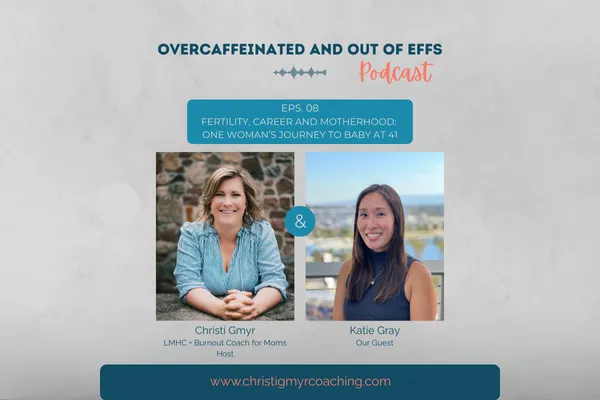
EPS. 08 Fertility, Career and Motherhood: One Woman's Journey to Baby at 41 - Transcript
Episode 08: Fertility, Career and Motherhood: One Woman's Journey to Baby at 41 - Transcript
[00:04] Christi Gmyr: Welcome to Overcaffeinated and Out of Effs, the podcast for burned out, career-minded moms who are ready to stop pretending everything's fine and feel like themselves again.
[00:15] I'm your host, Christi Gmyr, burnout coach for moms, licensed therapist and mom of two. And I'm here to help you reclaim your energy, your identity, and your peace of mind.
[00:25] Whether you're lying awake thinking about the 87 things you didn't get done or silently resenting the people you love most,
[00:32] This is your space to feel seen, supported, and not so alone.
[00:36] So grab your coffee, hot, cold or day old, and let's get into it.
[00:47] Hey everybody, it's Christi. Welcome to Over Caffeinated and Out of Effs. Today I'd like to welcome our guest, Katie Gray.
[00:56] Katie is a growth flower focused marketing leader with nearly two decades of experience helping companies scale through data driven strategy and compelling storytelling throughout. Throughout her career she's worked in a number of leadership positions and has expertise in customer acquisition,
[01:13] lifecycle marketing, brand development and digital transformation which she's used to lead high impact initiatives across multiple channels to drive meaningful business and revenue growth.
[01:24] Katie is also a brand new mom of a beautiful baby girl who will be five months old in just a couple days.
[01:32] So I've invited Katie today to share her story as a new mom who has also had a very successful, very demanding career. Because I really believe that her experiences include pieces that are going to resonate with so many other moms, although they might not necessarily be talking about it.
[01:53] You know Katie, she's going to talk about all of these things. We're going to get into all of this in more depth, but she's going to touch on a little bit about how at one time she didn't want kids and was very focused on her career.
[02:04] You know, that eventually changed.
[02:07] She's going to talk a little bit about what led to those changes,
[02:10] any challenges that she's had getting pregnant, her experiences with fertility and then becoming a first time mom at 41 while also starting a brand new job in a city she just recently moved to.
[02:24] One other thing that I want to mention that makes Katie a super special guest is that she is actually my best friend of over 30 years.
[02:32] We go way back, all the way to elementary school and we have been through a lot together.
[02:39] So I'm so excited that she's agreed to be a guest on this podcast because as I mentioned, I think her story and experiences are just going to bring so much value to those of you listening.
[02:48] So Katie,
[02:50] thank you so much for being here today.
[02:53] Katie Gray: Thank you for having me. I'm so excited to be a part of the podcast I've been listening to.
[02:58] Christi Gmyr: Yeah,
[02:58] well, so why don't you, you know, just start off by telling everybody just a little bit about yourself, you know, maybe a little bit about your family, your career,
[03:08] and what all of that maybe looked like for you before becoming a mom.
[03:14] Sure.
[03:15] Katie Gray: So I worked in pretty demanding jobs and careers by choice prior to becoming a parent,
[03:22] arguably after as well.
[03:24] But I started my career in New York City, essentially working at advertising agencies, which are notorious for having long hours. But you have fun, you work hard, play hard. I think is the epitome of that type of career.
[03:35] And I really did. I put in the hours. I worked really hard. I loved it. It's a very creative field. I worked more on the marketing strategy side of things.
[03:44] So not the creative piece, but the piece where you're working really closely with clients to come up with business plans and marketing strategies that are going to align to their goals.
[03:53] And I did that for 13 years in New York City and then decided right before the pandemic happened, before we even knew there was going to be a pandemic. I moved to Los Angeles with my partner for a different pace of life.
[04:06] I still wanted to have a career that I loved and enjoyed, but wanted to be able to do more balanced things outside of work. And for me, what that meant was being in a city where we could get outside and hike more, we could go to the beach, we could work really hard,
[04:21] but we could also drive 30 minutes and be in the mountains and spend the weekend at a cabin and just unplug from everything.
[04:28] I spent four, five years in Los Angeles working at news publications, which was its own challenge.
[04:36] I started right after the 2016 election, so news was very top of mind for a lot of people,
[04:42] but admittedly chose careers at different moments in the world and in my life where they demanded a lot of me. And I was willing to give that a hundred percent.
[04:53] Christi Gmyr: So I imagine, you know, that was obviously very different for you, you know, before having kids. And obviously, a lot has changed, I'm sure,
[05:02] you know, since your daughter was born, which, you know, I'm gonna want to hear. No, I'll ask you more about that in a minute. But I did want to just ask you, you know, you had.
[05:11] I know that for a long time, you know, when you were very focused on your career, you were very focused, you know, on your relationship with your partner.
[05:19] There was a time when you. When you didn't want kids, you didn't really see them as part of your future. And I'm wondering if you could just talk a little bit about what was behind that decision and, like, what you sort of envisioned your life to look like and be like without kids.
[05:39] Katie Gray: Yeah, it's not that I didn't. I always tell people it's not that I didn't like children, because I did. I babysat from when I was 12 years old.
[05:47] I have some young cousins in my family that I would always hang out with and take care of when we got together for family reunions. Like, I very much enjoyed other people's children, but it just wasn't something that I planned on for myself or had ever dreamt about, to be honest with you.
[06:02] I wasn't one of those girls that grew up and was like, I'm gonna be a mom or frankly, like, get married one day and all these things.
[06:08] And it's not that I didn't have models of successful relationships and families in my life. Frankly, you could say, like, my own nuclear family was a positive example because my parents are still together.
[06:20] They. They didn't get divorced when a lot of people's parents did growing up in the 90s, you know, and 2000s, when it started becoming, I think, more prevalent with my friend's parents.
[06:29] But it just wasn't something I ever thought would be for me.
[06:33] And part of it was just the work life balance, and part of it was I just didn't see myself as a mother. I did always see myself a dog parent that.
[06:43] That. That I did dream about since I was little. So I can relate to people when they're. They say, like, oh, I always thought I'd be a mother. And I.
[06:51] I knew even when I was young. Like, it sounds silly, but it's true. Like, I always knew I would have dogs, and I knew I would and really love them.
[07:00] And so it just wasn't something I thought about with babies, obviously, until three years ago. It was late in my life when I started.
[07:12] Christi Gmyr: Well, you know, and it's interesting, you know, that you talk about that, just because I think that there are actually a lot of people out there, a lot of women out there, especially today, who are really invested in their careers, and they don't necessarily,
[07:28] you know, plan to have kids or want to have kids. That's maybe just not the life that they are envisioning for themselves. I do think that it's something that people don't always talk about as openly just because of,
[07:41] you know, these societal expectations. Like, I Think a lot of people sort of get this message that as women, that's just part of the plan, right? That's what we're supposed to be doing, is we're supposed to be having kids and we're supposed to be wanting kids.
[07:53] And I don't know that that's really the case for everybody, you know? Well, I mean, I know it's not for everybody.
[07:59] And so I'm just wondering, you know, from your perspective,
[08:02] did you,
[08:03] like, did you ever feel any of that pressure? Whether it was direct or not, did you feel pressure from other places to have kids?
[08:13] Katie Gray: I never did, which is interesting. My parents have always been very supportive of my choices, and they are great. I think they recognize because I never talked about wanting kids.
[08:23] I never said, look, I'm never having kids, but I never voiced an interest in it. My parents aren't the kind of people who'd be like, hey, are we getting grandkids or have you considered this?
[08:31] Or, we really want grandkids. They just never, you know, they're really good listeners, and they've been really clear with me that all they want is for me to be happy.
[08:39] Which sounds cliche, but they're like, whatever that looks like for you. We want you to be happy. And there have been moments in my life where,
[08:45] you know, they've said, you know, you work really hard. We just want to make sure you're not putting too much effort in there, that you're giving yourself time, that you don't get burnt out.
[08:54] But they've never said to me, like, you have to have kids, or we want grandkids, which has been nice. So I never felt pressure there.
[09:01] And I don't. I don't think I've ever felt it from my friends either. Like, people like you, I've always been very happy for you and my friends when they have kids, and I know that's what you want and love celebrating
you and.
[09:11] And them. But,
[09:12] you know, none of my friends either. They've asked me, of course. Like, we've had conversations, because,
[09:18] friends, if we didn't. But never in a. Where it's like, why aren't you having kids? More like, oh, do you want kids? Is that something you see for yourself?
[09:25] But I really.
[09:27] I don't think I ever felt that pressure. In fact, starting a new job, it struck me that this is the first time in my career where when HR talks, benefits during onboarding, where I'm like, oh, I should pay attention.
[09:37] Because usually you're like, this is maternity leave, and this is what Healthcare looks like. I'm like, blah, blah, blah, who cares? I'm just.
[09:43] Dual plan. It doesn't matter.
[09:46] Christi Gmyr: Yeah, you should just like, tune all that stuff out. Yeah. Yeah.
[09:51] Katie Gray: Well.
[09:51] Christi Gmyr: And then obviously, you know, something's changed for you. I mean, you talked about,
[09:56] you know, not really thinking about kids until you were older, and so I hope it's okay. I'm gonna put this out there. You know, 41 years old,
[10:08] you know,
[10:09] obviously, you know, more and more people are having babies in their 40s, but more often we hear about people starting to at least think about or planning for babies, you know, in their 20s and 30s.
[10:19] And so I'm curious, like, what.
[10:22] What changed for you? You know, what influenced your decision to. To try for a baby and then change your mind?
[10:30] Katie Gray: It's interesting,
[10:31] or I think it's interesting in that my partner is actually the one who wanted kids and brought it to me. And I'll always appreciate,
[10:41] and this is part of what I love about him, but also really value in how he approached this conversation with me maybe four or five years ago,
[10:51] which is he never made it an ultimatum. And it was like, I want kids with or without you. It. The conversation was more like, I've been thinking about what life looks like down the road,
[11:02] and what we have now is really great, and I'm really happy.
[11:07] I think down the road it could be even greater if we had kids.
[11:11] If you don't want,
[11:13] I'm. I'm happy doing what we're doing now. And, like, I'm still choosing you. And that's the way he approached the conversation with me, which I really appreciate, because it wasn't like,
[11:24] this is happening whether you want it or not. I'm going to go get it. It was like, I'm choosing you,
[11:29] and I would blame us,
[11:31] but if it's not what you want, like, I. I still want this life that we have.
[11:36] So that changed the conversation.
[11:39] And we talked about it and thought about it,
[11:43] and honestly, like, I talked to my therapist about it too. And it wasn't that I was against having kids. I just truly had never considered it. I didn't think.
[11:53] Well, because I didn't think it was gonna my life. But in talking my partner more about it and my therapist about it and friends about it, I decided that it was something that I thought would be really special to do specifically with my partner.
[12:07] And a point I arrived at with my therapist that I think was helpful and I think is still true is that I.
[12:15] I don't necessarily want kids.
[12:17] What I wanted was to build a family with my partner.
[12:21] So if he will the picture,
[12:23] then no, I'm not one of those people who would have gone out and been like, I'm having a kid no matter what, at any cost. That's what I decided it was.
[12:29] I wanted to specifically start a family with him, and that's what changed.
[12:34] Christi Gmyr: Okay, so it sounds like, you know, you had a lot of support behind you. Again, you didn't have this pressure. It sounds like you were really given the space to think about things and reflect on things and figure out what you really wanted, which I imagine was,
[12:49] you know, was incredibly helpful for you. But initially, you know, when he first brought that up to you, so you said that it was something you had never even thought about before.
[12:57] Right. It wasn't that you didn't want, and you just never really considered it.
[13:01] So I'm curious, like, at the very beginning stages of those conversations,
[13:06] did those bring up any concerns for you about how that might affect your career, which you've obviously invested so much time and energy into your identity. You know, it's becoming a mom, Adding that to your identity.
[13:20] Identity, adding that to your roles is obviously a big change.
[13:24] Did you have any concerns around that?
[13:27] Katie Gray: Not initially. I.
[13:31] It seems so far away at that time. Like, I knew we wanted to get pregnant, and I knew that would be different for me than anything I'd experienced before. But I don't think I'd really conceptualized how things might change.
[13:44] I generally. I knew how things would change. Right. And I knew. We'll talk about. It's hard to be a mom and go back to work or like, to balance the two things.
[13:52] We've all heard the saying, like, you don't balance the things you do well at one or the other every day. And you kind of have days where one thing's up and the other's down.
[14:00] And that's just how it exists. I knew about that stuff, but the more detailed how it was going to feel, I didn't really have that expectations. I think in some ways that helped me because I never truly never thought I was gonna have kids.
[14:13] So I didn't have any expectations what that experience was gonna be like, what giving birth gonna be like.
[14:19] Christi Gmyr: I didn't.
[14:19] Katie Gray: I really. It's just along for the ride, really,
[14:22] to be there. But I wasn't like, oh, I always thought that I would have the baby in this setting. There'd be candles and what. I was just like, I'm gonna have the baby.
[14:30] Christi Gmyr: I don't know what's gonna happen.
[14:31] Katie Gray: I've never really thought about it before, but now I'm thinking about it and we're gonna see how it goes. And I kind of felt the same way about how I'd approach my career afterwards.
[14:40] I knew that I was going to go back to work. I just didn't know the details yet other than I was going to go back to work. And knowing from friends like you that I had signed up from daycare for daycare early and get bills in order, the emotional side of it,
[14:53] I didn't really know what to expect. I didn't have a lot of.
[14:57] I don't want to say thought that I put into it because I was mindful about it, but I just didn't know what was coming.
[15:03] Christi Gmyr: So sort of like,
[15:05] this is coming. I know it's going to be different, but I don't know what. I don't know. I'm just going to kind of be open to it and roll with it and sort of, like, figure things out as it happens.
[15:14] Katie Gray: Exactly. Exactly.
[15:16] Christi Gmyr: Yeah. Yeah. Okay.
[15:18] So I'm gonna switch gears just a little bit and I'm gonna bring up a topic that I know can be a bit sensitive.
[15:26] And I wanna. And I know that this is something that a lot of moms experience, but they don't always feel comfortable talking about it. And I know you have been very open about this and.
[15:36] And I had asked you ahead of time if it would be okay for me to ask you and had said yes. And so I really appreciate your willingness, but that's your fertility journey.
[15:44] Right. And so I'm wondering if you can talk a little bit about that and what that was like for you, both emotionally and physically.
[15:55] Katie Gray: Yeah, I had that conversation with my partner about starting a family when I was, I want to say, 38.
[16:04] And so my first thought was we should. We should do IVF or freeze my eggs. Because at the time, we knew we wanted to leave Los Angeles, but we didn't exactly know where we were going to move.
[16:15] And we knew we wanted to start a family, but we didn't know exactly how that was going to happen. But I knew my age was going to be a factor, and so that was my first thought.
[16:25] And I think egg freezing is something some of my friends have done when they were younger,
[16:29] and I knew it was something that helped safeguard for your ability to have children in the future.
[16:35] So we. We started IVF right away. We went to see the doctor,
[16:39] a fertility specialist, and he was. He basically talked to us about the options and essentially told us that if you.
[16:46] If you know who you want the father of your children to be. In this case we did. Then he's like, you have better success rates. Freezing embryos than freezing eggs will freeze embryos.
[16:57] Like let's do that process. So similar, you do the egg harvesting, then you actually make the embryos and you freeze those versus freezing the egg.
[17:05] So we went through that process and we ended up with no viable embryos. I think we had seven eggs that he harvested,
[17:13] made five embryos which we were really excited about. And then only two like made it past the first two days. And then only one made it past like the blastocyst age.
[17:23] It's like the five days and then that one was genetically tested and it wasn't viable.
[17:28] So we disappointed.
[17:30] We also, I always tell people we also kind of went about it backwards because we,
[17:35] we didn't know.
[17:36] Christi Gmyr: Right.
[17:37] Katie Gray: And I don't regret it because we learned so much about fertility and health and how to go about things from that process. Even though it was really disappointing and very expensive.
[17:49] It was sad to not be able to have anything at the end of that whole process. But we also,
[17:54] we also tried that redeem and tried to get in our own.
[17:57] So we were like pause and try to get pregnant naturally just while we move, we move to
another state and then if we don't get pregnant by the time we like move into our new house, then we'll try IVF again.
[18:10] That was our plan.
[18:11] We moved and we met with my fertility doctor in our new city.
[18:16] We had all the plans made and I had heard from several friends that agriculture could help fertility outcomes when you do IVF.
[18:23] So I found a fertility specialist, luckily really close to where we live.
[18:27] Worked with her, she's lovely.
[18:30] Never over promised anything. She's open with me about like we're going to work towards positive outcomes with the egg harvesting and then I'll through if you helps because I did have a high stress job as well and she was talking about that's a lot of what I could do to help with the outcomes.
[18:50] So I started acupuncture and then within two weeks of doing it actually got pregnant on my own. Which was shocking. We didn't even something that could happen unfortunately that was a chemical pregnancy so that you know, that wasn't viable.
[19:07] So then we were disappointed again after being so we were like, wow, this happened. And then it was just really sad and upsetting and disappointing.
[19:16] But my acupuncturist, you know, she's a, an angel.
[19:20] She was like, you know what, let's just Keep working towards your IVF outcomes. You can still do that. I'm going to work with you two months, I guess 90 days or 60 to 90 days is when you can have the most positive impact using acupuncture for IVF.
[19:33] So we just on that road and she was like, but while we do this, why don't you keep trying to get pregnant? And then if you get pregnant, four great, and if you don't, you still have your IVF.
[19:41] And then a month later I got pregnant. And that pregnancy luckily was healthy. And that was. My daughter.
[19:50] Christi Gmyr: Is amazing, you know, and she is,
[19:54] oh my gosh, the most adorable little baby.
[19:58] And I. Yeah, and I really appreciate, you know, you talking about that because again, I feel like this is something that so many people go through and I think it's something that feels very isolating for a lot of people because they're, you know, they're not always talking about it.
[20:14] And so I really appreciate you sharing that.
[20:17] Do you feel like having your first baby, you know, in your 40s,
[20:22] do you feel like that brought on any extra challenges for you? You know, either physically, mentally, emotionally,
[20:27] versus having them, you know, starting to have kids in your 20s or 30s?
[20:33] Katie Gray: I do.
[20:34] It's funny, my dad said something to me a while ago before I knew I wanted to have kids. We were talking about something else.
[20:41] But he was saying how there's two choices. You either choose to have kids when you're young and you grow up with them, or you choose to have kids when you're a little older and you do your growing up first and then you have them.
[20:52] And he was like, you know, no, no one answer is right, but that's kind of the two ways you do it. And I thought that was really insightful. And I, I do think that's true.
[21:00] And I definitely did my drawing up first.
[21:02] I will say I was talking to my partner about this the other day.
[21:06] Having a child in my 40s,
[21:09] feel very lucky and fortunate that she's healthy and everything. We took a lot of steps to, to do everything we could to make that possible. I was also very careful during my pregnancy.
[21:18] Cause I was really,
[21:19] I think as a, you know, first time pregnant person, just like nervous about everything. And you read like, you shouldn't eat tuna, but you can eat some, don't eat sushi, but maybe it's okay at all.
[21:28] And I just avoided everything because I was just really nervous regardless of my age. But then the age I was reminded of during every appointment because in my chart and the doctors, they're like, oh, you're ama.
[21:39] Advanced maternal age. Oh, you're ama. So we should do this.
[21:43] During the last trimester of my pregnancy, I would get a non stress test every week just to make sure the baby, even though everything had been healthy and good up till then, she was still picking and moving as she should.
[21:54] But there were just moments where I was reminded of it. Made me feel a little self conscious at times because I was like, oh, this is something extra I go through because I chose to wait so long.
[22:05] I never felt guilty about it, but it was just always present.
[22:09] And it's funny, it's something sometimes I feel like I have to qualify my experience with when I talk to other moms, like,
[22:16] oh, and I'm 41 and I just had my first baby. But I'm trying not to do that so much because I think sometimes it, it makes me feel like it's invalidating my experience a little bit or like that's the whole focus of my experience when it was a part of it.
[22:34] But it, for me, it wasn't part of the journey.
[22:37] But then my partner was telling,
[22:40] he sees it a really different way where he's like, I think the fact that you can have a baby when you're 41 is inspirational and it gives other people hope and it makes them realize like, they could do it too.
[22:52] And that's why you should share it. Oh, when he said that, I was like, oh, I get, yeah, I guess I can see the other side of it. I didn't think of it as inspirational.
[22:58] Sometimes it feels more like,
[23:01] not shameful, but like, oh, I waited so long and now I got to have this baby. And that's so great, but maybe I shouldn't have waited so long. And then it brings up all these conversations with whoever I'm talking to about like, however they feel about their age.
[23:13] And it's always complicated by individual how I feel.
[23:18] Christi Gmyr: Well, yeah, and I feel like that also goes back to what I was talking about a little bit about, you know, a little bit before about like these societal expectations and these pressures that are put on us.
[23:26] Like I was talking about it earlier in the sense of having babies at all. But the reality is, is that there are pressures and there are expectations coming from other people.
[23:35] Sometimes they're one, they're, you know, expectations that we sort of assume or anticipate, you know, are coming from other people. And a lot of times that can be part of our conversations, you know.
[23:47] But to your point,
[23:50] you know, everybody's experiences and journeys are very, very different,
[23:54] you know, but there are a lot of things that are. Can have some similarities. Right. And so,
[24:00] yeah, like, it sounds like there are maybe some challenges that came along with it, but I love how, you know, he talked about it being inspirational because, yes, there are a lot of women, especially I think, nowadays who are wanting to have kids at an older age.
[24:13] And so, yeah, I agree that it's.
[24:16] I imagine it's very helpful for them to be able to. To hear a story like this. And can I just say, by the way, you didn't use this word, but I feel like this was the word I always heard all the time because I also had babies, you know,
[24:27] a little bit older pregnancy term. I don't know. I feel like they need to come up with something better than that, like, understand it. But also, it's like,
[24:39] I'm in my 30s and you're using the word geriatric.
[24:44] Katie Gray: Yeah, that never.
[24:45] That never feels great. And the other thing that I just want to mention is,
[24:49] you know, I had a really great support system. All my friends like you,
[24:53] when I was going through it, and I was like, oh, I wonder if it's weird that I'm like, 41 and pregnant for the first time. Time. And then I reflected on it while I was pregnant, and I was like, you know, no one who I've told has been like,
[25:02] but you're 41.
[25:04] Everyone especially you were like,
[25:07] I'm so happy for you. Congratulations. And, you know, people just wanted to know how I was feeling, how the baby's doing. Like, no one cared how old I was. And so a lot of that was just in my head as well.
[25:17] But I think when you're going to every doctor's appointment and they're like, oh, you have a geriatric pregnancy,
[25:22] that helps to keep it in your mind.
[25:24] Christi Gmyr: Yeah, yeah. No, it's hard to. It's hard to get away from that.
[25:28] So now she is almost five months old,
[25:32] you know, and I.
[25:34] One of the things that I mentioned earlier, but just as a reminder for the people listening, you know, that just recently started,
[25:40] not only did you just come back from your maternity leave just a few weeks ago,
[25:45] but you came back to a brand new job, right? You're also starting a new job at this same time.
[25:52] And so there were a few big changes that were happening all at once. And I'm wondering, like, how did you feel? Like, how did it feel for you as you were getting closer to the end of your leave and then preparing to go back to work?
[26:03] And then just like, what was that transition, like for you.
[26:07] Katie Gray: It was surprising to me how sad I felt about it. I mentioned earlier that I didn't have expectations about being pregnant or having baby or frankly, like work, life, balance. Like, I didn't have an expectation for myself.
[26:20] I knew those would all be moments of change to transformation,
[26:23] but I didn't know what it would look like for me.
[26:26] And when I was getting ready to go back to work, I'd say starting a month before, I knew it was gonna weigh heavy on me. I could just feel that I was dreading it a little bit.
[26:37] Not, I wasn't dreading starting work at a new place that I was excited about, but I was dreading having to leave her. Because for every single day of her life up until then, I was with her and taking care of her.
[26:49]
And then to think about not being there for her was just gut wrenching.
[26:54] And I remember the night before I started my job, I was just sobbing and I went to my partner and I was like, I'm just so sad.
[27:04] Christi Gmyr: Because she means so much to me. And he's like, she, it'll be okay. It's gonna be okay.
[27:09] Katie Gray: He was very reassuring.
[27:11] And then I remember putting her down for bed that night and I was just so,
[27:15] so sad. And I was just staring at her and feeling like I was leaving her and abandoning her in her moment of need. And then of course, she was fine.
[27:24] I was at work and everyone was like, she smiled and she played all day and she was great,
[27:28] you know, and then I would when I came home.
[27:31] So that was really hard. But navigated through that. I'm only on week three right now, so I can't. I don't know. There's certain challenges ahead that I'll face up. Sure that I haven't even been a.
[27:41] And then starting a new job felt really exciting and new and fresh and, you know, getting to meet new people and I'm going in the office a few days a week.
[27:51] That was cool, but also nerve wracking. But everyone's been so welcoming and supportive.
[27:57] I've just been really open within them. I think I've tried to be very transparent as a leader at work, but I would say that now extends to my work, life, balance,
[28:06] discussions with them. Because I've been leaving at 5 o' clock every day to come home. Because by the time I get home, I see my daughter for 45 minutes, then before she goes to bed, if I leave it by, if I leave.
[28:17] Christi Gmyr: After, you know, I don't at all.
[28:19] Katie Gray: And certainly there are days where that's going to happen.
[28:23] But we try to leave right at 5. And I've just been telling people, like, here's why I leave. I'll get back on email when I get home if I need to, but I'm just trying to put it out there so everyone knows going on and I don't have to apologize for it,
[28:35] but I also want to make sure people know I'm not choking my duties or it's not that I don't care about them or.
[28:43] Christi Gmyr: Yeah. Well, now also, it sounds like you're managing expectations, right, by setting those boundaries. I mean, boundaries is something we talk about all the time, you know, and I think that they're so important and they're so helpful,
[28:55] but they can be harder sometimes to implement them later, you know, by starting them like right off the bat, by putting in place and managing people's expectations.
[29:04] I imagine that that probably helps a little bit with that too. Right. Like, they know, like, you,
[29:12] you've got to leave at 5 o' clock and you'll make sure that you're fulfilling all those responsibilities, like you said.
[29:19] And in terms of like what you had said about going back to, you know, daycare and just feeling like the sadness and,
[29:25] you know, you know, having her start there. And I feel like, yes, that's another thing. I mean, I personally had like the exact same experience, right. Where just going back to daycare was initially one of the hardest, hardest things, you know, for me.
[29:41] And then, shoot, then my kids are stuck. Right. And I really think that a lot of people told me that they would be and they were. And it did get easier over time,
[29:50] you know, And I honestly think a lot of times it's on us than it is on them because, yeah, like, there are all these fears, all these feelings, all these things that come up.
[30:00] But yeah, they're, they're okay. And I'm glad to hear that you've been having that experience too. I mean, I know it's still new and you're still transitioning, but.
[30:08] But yeah, I'm glad to hear she's off to a good start with that.
[30:12] Yeah.
[30:12] Katie Gray: So it's been,
[30:13] it's been a journey. Sorry. Yeah. And one of the things that helped me to. I hope I'm not over sharing isn't talking to people like you.
[30:20] And you told me you were like,
[30:22] I hear all your feelings. I felt those too. And then you told me you're like, you know, there came a point where I felt all those things you do. And then I was really glad I had Daycare, because even on days when I didn't have to go to the office to work,
[30:33] I would still take the kids because I had other stuff to get done. And I was like, okay,
[30:37] I know you love your kids so much. And I'm like, if you feel that way or felt that way, then I know I will get there, too, and it's gonna be okay.
[30:46] Christi Gmyr: Yeah. And I also. Just. One of the things that I want to mention about that, too, is I think that a lot of moms also struggle with this idea.
[30:54] Not just an idea. I think a lot of times it happens is this judgment that we get from other moms who maybe do things differently, you know, and we all.
[31:02] We all need to do things in a way that works best for us. And I've heard people make comments before about how, like, oh, well, it's been out working.
[31:11] Why are you sending your kids to daycare? Right. And it can feel.
[31:15] It doesn't feel great hearing those comments. But honestly, I don't let those things bother me because I know I'm not doing anything wrong. Like, I have to do these things one way or another, and I can either do them, like, get my chores and stuff done while my kids are at daycare,
[31:31] or I can scramble and struggle to do them on the weekend when I'm trying to spend that time with them that. You know what I mean? So I think that it's completely fine for people to do things in that way.
[31:43] You know, you just have to do things in a way that works best for you.
[31:46] But also,
[31:48] even if people don't agree with it, even if other people want to do things differently, like, that's okay. That's their choice, that's their journey. But.
[31:56] But it's still okay to do things, you know, in this other way, too, even if people don't agree.
[32:02] So what would you say has surprised you most about motherhood so far?
[32:09] Katie Gray: I was thinking about this question a lot, and this is a very tactical answer. But honestly, the breastfeeding,
[32:15] that has been a journey.
[32:17] And I know.
[32:18] I know from other moms like you and from visiting you after you had your first child,
[32:23] I know it's a thing. Like, I knew it was a thing that people do, and that takes a lot of work and time. I think I didn't realize how much of a commitment it was until,
[32:33] you know, being in it and having my daughter. And I also think people don't talk about it in as much detail because they don't want to scare you off from doing it.
[32:42] I don't think people hide things, but I don't think they really go through the nitty of it until you're in it and you're like, oh my God, this is insane.
[32:50] Like I didn't.
[32:51] Naively I didn't realize that like having my daughter.
[32:55] So maybe tmi, but I've been pumping for her since she was three days old. Cause she had jaundice. And so when she actually had to be hospitalized for it, she's totally fine.
[33:04] But you had to get light therapy. A lot of babies do.
[33:07] The lactation consultants and doctors had me start pumping for her to make sure she was getting enough food so that she could get the bilirubin out of her system and get rid of the jaundice.
[33:16] So she was pumping from a bottle at three days old. And initially everyone was saying wait until they're three or four weeks old or even longer until you give them a bottle so they don't have nipple confusion.
[33:26] So I, I had no idea what I had this breast pump and I had no idea what to do with it. And the nurses were like, okay, just start using it.
[33:32] And I was like, how, what, what.
[33:34] Christi Gmyr: Am I supposed to do?
[33:35] Katie Gray: So they showed me.
[33:37] But the fact that it's really a lifestyle, like I'm still pumping every three hours for her and that's whether I'm in the office that day or not and trying to make enough milk for her.
[33:47] I remember she was a month old and we were already. I maybe had like six little bags of personal frozen and we already started to have to use them because she was going through a growth spurt and I was panicking because I was like, I don't have enough milk.
[33:59] I'm not going to make it.
[34:00] So I would ask you who been more experienced with it, like what you did and tried to learn. But that has been the most surprising. It is a privilege to be able to provide for her and feed her.
[34:10] It's also, it's a lifestyle for the next year. And it's also like I guess I should I this none of my old fit. I kind of the baby.
[34:19] Oh, I'm like down to my preferences now. Well, I'm gonna be like this for as long as I'm pumping some her and I'm getting to a place where I'm okay with that like physically look and physically how it makes me feel.
[34:35] But that's been a transition too.
[34:38] Christi Gmyr: Yeah.
[34:40] So many things are coming to mind for me right now. Like as I'm listening to you talk, you know, and I do think that Breastfeeding? Yeah, it's one of those things, again, that I think catches so many people off guard.
[34:50] You know, it's one of those things that I personally never really heard people talking about, you know, the challenges that come with that. You know, you go to these, you know, classes to learn about what it's going to be like, you know, after you.
[35:02] Your baby is born and they're showing, like, the baby just naturally going to the nipple and everything is just so easy, seemingly easy, and all of that. And I'm sure some people have that experience, but for so many people, it is very different, you know.
[35:17] And to your point, yes, it is a lifestyle. It's not just a, hey,
[35:21] let me do this, and then I'm done with it.
Like, it's something that consumes our lives for a very big period of time, no matter what that looks like. Right.
[35:29] So it could be breastfeeding, it could be pumping, it could be formula feeding. It could be some combination of everything. You know,
[35:36] I do think that that's something that catches a lot of people off guard. And again, something that I think sometimes people are feeling pressure or maybe there are some judgment around the decisions, you know, but we're all just doing the best we can.
[35:48] Right. And at the end of the day, like, as long as. To your point, she's fed, she's healthy, you know, I mean, that's.
[35:55] And you're doing everything in a way, like, you figured out a way that it does work for your life, which is obviously really important, too.
[36:03] Katie Gray: Yeah, it's been. It's a continuous. To be a journey.
[36:06] Christi Gmyr: Yes. Continues to be a journey. A journey that will continue forever.
[36:11] Maybe not this stage, but parenthood in general.
[36:14] Okay. So. Well,
[36:16] I know that people are very busy.
[36:18] Katie Gray: You're very busy, I'm very busy.
[36:20] Christi Gmyr: And actually, like, I just want to sort of mention to people, and I said this to you before we even started the conversation about how I would maybe let people know that we're meeting on a Sunday morning, because that was the time that just worked with our schedule.
[36:34] The best night here for. In the background making noises, I hear my own kids bumping around downstairs. And I just sort of wanted to call attention to that for anybody who is maybe hearing it, because,
[36:44] again, like, this is something that I think that we all sort of deal with, we all sort of experience. And it's just part of. Part of the gift. Right. Part of managing our lives and all the things that go with that.
[36:56] So before we wrap up, though, like, if you could just say, you know, Maybe one thing to the other women who are listening, who are unsure if motherhood is for them or maybe they're having a hard time conceiving.
[37:10] What would you tell them? Do you have any advice or any words of encouragement?
[37:18] Katie Gray: What worked for me and I'm mindful that like you said with the breastfeeding, like it looks different for every person and what works and doesn't work for you is different and every answer is good.
[37:28] I would say that about my response too.
[37:32] For me, what worked is widening my village of support,
[37:36] especially my fertility journey. There were moments where I felt like I wanted to keep my circle small. Who knew about it and what I was doing because I wanted to myself.
[37:47] Not that I thought anyone would be critical, but just when you go through something big, you're like, oh, do I want to tell 40 people that didn't work Now I just felt like I was small.
[37:57] It was actually my partner who when we went through the chemical pregnancy, he was like,
[38:02] he saw what I was going through and he needs support. And I'm happy I haven't been in need support. I'm always here for you, but I think you need more than what I alone can give you and make sure you're okay.
[38:17] And that was the best thing for me to hear was basically wide in my village and then we told my parents.
[38:26] I think I had already told you,
[38:29] but if I had it, I talked to people about it in detail then about what was happening and I just widened my village a little bit and what that actually I was worried would have expectations of me that I would be letting them down honestly if things didn't work out.
[38:43] But what it meant was I had so much support from people who I care about and who cared about me, like you. And you were great about, you know me like are you at.
[38:53] So I got depressed, but it was like, are you about me and supporting me? How are you feeling? And that made me feel so good every time I heard from you.
[39:02] Even though we live far apart,
[39:04] my parents,
[39:08] it really helped me to get through times that felt very difficult because I knew that no matter what happened, there were people who loved me and that I would be okay.
[39:18] That would be my advice for people who are feeling like studying with fertility and maybe have to keep their widening out feels maybe on. Well, it did, but it actually makes me feel really hoarded.
[39:33] And then when I did have great too, of course made me feel okay.
[39:40] People who I know love and support me and no matter what they're going to be for me.
[39:45] What was even more exciting to tell people my needs and I'm to be.
[39:53] Christi Gmyr: Yeah, no, I think that that's. That's really great advice. You know,
[39:57] support system. Having a support system is something that obviously we talk a lot about, too. But I do think that people struggle sometimes to lean on their support at times for a number of different reasons.
[40:10] You know, whether it's,
[40:12] I don't want to be, quote, unquote, burdening them or, you know,
[40:16] their own lives or whatever, or. In your point, I mean, like you said,
[40:19] the things that we're dealing with were very personal,
[40:22] and maybe it felt a little bit safer at times to keep that closer. But,
[40:28] yeah, like our friends and family, I think it's important to remember that the people who are closest to us, they want to be there for us, they want to support us, they want to help us through things because they care, you know, and so.
[40:39] And it's really, really not just a. Okay, but it's a really positive thing. You know,
[40:45] just in general,
[40:46] whenever we're going through a hard time,
[40:49] we tend to move through those things better when we are able to use our support. So I think that that's. That's a really great point.
[40:58] So I guess, you know, I just wanted to thank you again, you know, so much for being here. That's probably a good place for us to wrap up for today,
[41:06] you know, And I know you're very, very busy, and so I just.
[41:09] I think that this was so awesome. I think that there was so much helpful information there that I think is really going to resonate with a lot of people. So I really do appreciate that,
[41:18] you know, and to all the moms who are listening, you know, as always, you hear me say this, that if any of this does resonate with you or, you know, you found things that we talked about today to be helpful,
[41:30] you know, please just remember to share this with any other moms, you know,
[41:35] hopefully they give you some additional support, too,
[41:38] because, again, we are all in this together.
