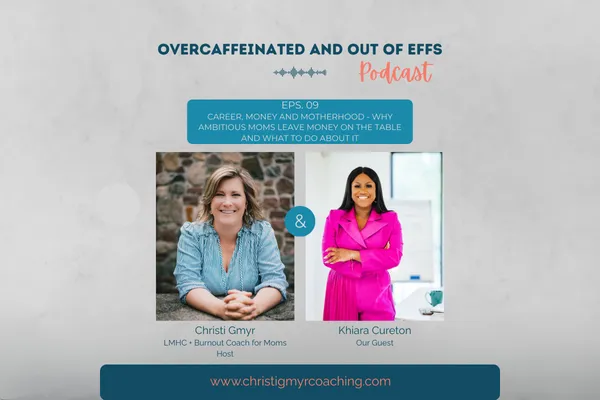
EPS. 09 Career, Money and Motherhood - Why Ambitious Moms Leave Money on the Table and What to Do About It - Transcript
Episode 9: Career, Money and Motherhood – Why Ambitious Moms Leave Money on the Table and What to Do About It - Transcript
[00:04] Christi Gmyr: Welcome to Overcaffeinated and Out of Effs, the podcast for burned out, career-minded moms who are ready to stop pretending everything's fine and feel like themselves again.
[00:15] I'm your host, Christi Gmyr, burnout coach for moms, licensed therapist and mom of two. And I'm here to help you reclaim your energy, your identity, and your peace of mind.
[00:25] Whether you're lying awake thinking about the 87 things you didn't get done or silently resenting the people you love most,
[00:32] This is your space to feel seen, supported, and not so alone.
[00:36] So grab your coffee, hot, cold or day old, and let's get into it.
[00:47] Hey, everybody, it's Christi.
[00:49] Welcome to Overcaffeinated and out of Effs.
[00:53] Today I would like to welcome our guest, Khiara Cureton,
[00:57] an executive coach, career and wealth coach, and founder of Anchor Co,
[01:02] where she helps ambitious mothers break through the middle management ceiling, secure their first executive role,
[01:09] build wealth and financial freedom while still being present in motherhood,
[01:15] all without burnout or guilt.
[01:18] So I've invited her today to talk about career, money, motherhood, ambition,
[01:25] why they have to coexist, and how to build around them.
[01:31] So, Khiara, thank you so much for being here today.
[01:35] Khiara Cureton: Thank you so much for inviting me. I'm very excited about this conversation.
[01:38] Christi Gmyr: Yes, I am too.
[01:40] So why don't you, if you don't mind, why don't you just start off by telling us a little bit about,
[01:44] you know, your story and how you got into this work.
[01:48] Khiara Cureton: Absolutely.
[01:49] So, first of all, I love the title of this podcast.
[01:54] It is so relatable.
[01:56] But, yes, my name is Khiara Cureton, and I have always been ambitious, and I think ambitious means different things for different people. I know. You know, previously,
[02:08] you know, ambition has kind of been a dirty word, but then it was praise. Like, it's. It's been through a lot, right? The word ambition has been through a lot, especially as it relates to women and even more particularly mothers.
[02:17] And so I was a traveling Monday through Thursday consultant on the road all the time, and we found out that we were expecting right before 2020. And I was also going up for promotion.
[02:33] And so I felt like I was at a crossroads because I knew the kind of mother I wanted to be. And I wanted to be present not at everything, but like, you know, at some things.
[02:42] And that would be very hard to do with my current, you know, setup. And so I had career mentors and I had a financial advisor, but I feel like they weren't singing the same tune.
[02:55] You know, it was like, oh, More about retirement and then the career advisors go ahead and after the career. So I felt like there was a resource missing that was truly looking at your career, your ambition, and then your overall, you know, money, personal finance, goals,
[03:10] all cohesively. And so I started anchor because I wanted to be a resource for those other mothers who,
[03:16] you know, also were ambitious and still wanted to continue to grow in their careers financially as well, but then also, you know, this new chapter of motherhood and supporting them through that.
[03:26] Christi Gmyr: Okay, great.
[03:27] Well, and I do think that, you know, as I'm listening to you talk, I do think that motherhood and career, that's something that we talk about a lot. You know, that's something that a lot of people are,
[03:41] you know, doing. They're doing all the both of the things,
[03:44] you know. But one of the things that I feel like is often left out of the conversation is this piece specifically about money. Right. And so I'm really excited to talk more about this today, but I'm wondering if you can just maybe start off with the big question.
[03:59] So when you talk about how career, money, motherhood, ambition, they all must coexist, can you just talk a little bit more about what you mean by that?
[04:09] Khiara Cureton: Absolutely. So how I kind of tell it to my clients is that these things aren't four separate buckets. They're completely intertwined. So if you think about it, your career fuels your income, your money choices create that stability for your overall family, and then motherhood is huge, and it.
[04:28] It impacts and it shapes how you lead and what you overall value. And then that ambition piece of it, to me is like the engine that drives all of it forward.
[04:37] So too often, as you mentioned, we are told we have to pick one, pick a lane. Either you climb in your career or you're present and prioritize your family or focus on the money.
[04:48] Later it'll come.
[04:50] But that narrative is what keeps us small.
[04:54] So for me, I always. I've always preached that your career, money, motherhood, and ambition must all coexist. And you don't have to choose.
[05:03] You know, you're building something on your own terms, holistically.
[05:08] Christi Gmyr: Okay, great. Well, thank you so much. Yeah. Because I. I agree with you too. Like, a lot of times, I think it can be really easy to sort of focus on or to sort of have this idea that we have to focus on, you know, one thing or another when really there are a lot of floating parts,
[05:22] there are a lot of floating pieces. And so,
[05:25] yeah, I think that that's really helpful. So with that in mind,
[05:29] you know,
[05:31] a lot of these moms who maybe feel like they have to do one lane or the other, but there. There are a lot of lanes to. To go down, you know,
[05:40] and to your point, they all do coexist. And so as they're trying to,
[05:45] you know, do all of these things go down all these paths at the same time, there. There can be a lot of guilt, right? Because this idea that I have to pick one or the other and the guilt is coming from a lot of different directions.
[05:56] So when we're talking about, you know, career growth in particular,
[06:00] I'm curious, like, how do you work with people around that? Like, what are some of the maybe mindset shifts that maybe need to happen for these moms so they can help manage that guilt?
[06:12] And how do you help them move past that?
[06:15] Khiara Cureton: Absolutely. So, as you mentioned, you know, guilt is coming, I feel like, a lot of times internally, too, but a lot from our outside sources. And so usually I see people are.
[06:25] You know, they think guilt comes from the belief that your ambition or your drive is taking away from your children or from your family.
[06:32] But in reality, your ambition adds to it. So your kids. What I always tell people, and this I feel like makes it really sink in for folks, is your kids are watching what you're modeling, right?
[06:43] So you're modeling what's possible,
[06:46] potentially modeling what's not possible.
[06:48] So that mindset shift that really needs to happen is ambition isn't selfish.
[06:53] It's truly a gift for yourself. And I always remind my clients, you cannot pour from an empty cup. And you are a better mother,
[07:00] partner, executive,
[07:02] et cetera, at all the titles and many hats that we wear when your cup is filled.
[07:07] So, you know, again, it shows your children what leadership looks like and confidence and courage.
[07:14] And so I just help my clients reframe and say, okay, one is to create that awareness, right? Like, what does guilt look and feel like for me? Is it like my chest getting tired?
[07:23] Is my throat, you know, feeling dry?
[07:26] And then just take a pause, take a breath, and then, you know, ask themselves, for example, what story am I showing my kids about what's possible, Right?
[07:36] And then another big one that I like to is replacing balance,
[07:41] because I don't love that word. I like to change it with, you know, I don't believe in work life balance. I think it's work life integration,
[07:48] but replacing that word balance with either integration or boundaries, right? So it's not about doing everything. It's about doing the things that truly matter to you. And again, everyone's their drive.
[08:02] Everyone's lane, if you will, is going to be different. Right. Because. Because what drives me may not drive you and vice versa.
[08:09] Christi Gmyr: Well, and those things might change, too. Right. So depending on where we are in our lives and our careers, you know, circumstances change, our priorities might change and what that looks like.
[08:19] So to your point, maybe not doing all the things, but doing the things that are most important at any particular time and adjusting as necessary.
[08:28] Yeah. And in terms of, like, the guilt, I mean, I really like what you talked about in terms of this refrain, because,
[08:34] you know, one of the things that I often talk to people about is this idea with guilt, you know, the mindset piece. Right. And that maybe we're either having a belief that we're doing something wrong or we're letting somebody down in some way.
[08:45] But really,
[08:48] for you starters, it's not selfish. We're not doing anything wrong. But also, to your point, taking it a step further, there could be a lot of benefits. There can be.
[08:55] It's not just that we're not harming our kids or doing anything that's better for them or anything like that, but this idea that they are learning through what they're observing, they're learning from, you know, words or talking to them about it helps them develop skills.
[09:08] And so it can actually be like a. Like a really positive thing for them, you know, which it sounds like, that's one of the things that you. You help people with a lot.
[09:15] Khiara Cureton: Agreed. And. And the first step, even peeling
before that is clarity. Again,
[09:20] what matters to me. I love you. Said it beautifully. What matters to me in this season. Right.
[09:25] And then once you understand what that. Not what society's telling me, not what, you know, corporate is telling me or. Or what Instagram is telling me.
[09:32] What do I want deep down. And then that should be your driver.
[09:37] Christi Gmyr: Yeah. Yeah. Okay. No, that. That makes sense.
[09:40] So you had mentioned, you know, in your bio that you help moms build wealth. I'm going to come back to the money piece. Right. So you help moms build wealth and financial freedom.
[09:51] So what does that. What does that look like in more practical terms?
[09:55] Khiara Cureton: Yeah, I feel like for women, it's often, you know, just salary negotiation, which I am a big proponent of. But it's not just about earning more. It's about managing and growing what you have.
[10:07] As we know, I feel like in the conversations that I've been in, women don't feel comfortable talking about money the way some of our counterparts do.
[10:16] Even in our friend circles, even in our most trusted friend circles, so for my clients, wealth building means creating a money routine that feels almost as natural as, like, a workout.
[10:27] Right. And I know workouts are kind of hit or miss nowadays. We're so busy or on caffeine, etc. But basically, what I'm trying to say with that is create a system that works for you so practically that'll look like knowing your numbers.
[10:40] I always. I do an exercise that I absolutely love in the beginning of our coaching sessions,
[10:46] where I sit with my client, we share screens, and we go through the last three months of the statements, right?
[10:54] So initially we'll say, okay, like, what is your spending plan? What do you think you're spending on Chick Fil. A monthly during baseball season or gymnastics season. Right. It's like, oh, I'm spending, you know, $60 a month.
[11:05] And then when you get that clarity and actually see line by line, like, wow, like, you know,
[11:11] it kind of lights something up for folks. And then I ask them, the way you're spending, is that currently aligned with your values or not? So, again, knowing your numbers, just the simple things.
[11:20] Automatic automating savings.
[11:23] And it doesn't always have to be these big, large numbers. Investing early and then again, being very comfortable with talking about money without shame. So I always encourage my clients just, if you have so much resistance, one, let's figure out where that resistance is coming from.
[11:39] Which is why I start at the foundation of really understanding your money story and your career story. But for this particular thing, your money story, because there may be some things in childhood that you're not connecting the dots to that may have you a little bit resistant to talking about money.
[11:54] And again, just. Just knowing your numbers, knowing what's coming in, knowing what's going out. And I really encourage. I call them money circles. It could be two people. It could be four girlfriends.
[12:05] Like, just starting to talk about that amongst trusted peers makes all the difference.
[12:12] Christi Gmyr: Now, I'm curious just because, like, yes, I think that it's super important that moms are not feeling like they're doing anything wrong. Right. And that they're certainly not alone in the struggles that.
[12:22] Or challenges that they are having. So just out of curiosity, when you first start working with people,
[12:26] do you find that most moms do know all their numbers, or is that something that is a. It's a shift that they then have to work towards making?
[12:36] Khiara Cureton: Absolutely.
[12:37] Is a shift that they have to work towards.
[12:40] Um,
[12:41] they would. I. It. It breaks my heart a little bit to say this, but I will say at least 50% of them are Like, I don't even know my partner handles the money, and I'm like,
[12:51] like, I get it, and that's a blessing. But I still want you to know the numbers as well. Like, let's make this more of a partnership. For all the reasons that I could go into.
[12:59] Women live longer, healthcare costs are higher, all the fun data,
[13:04] you know, statistics behind that.
[13:06] Um, but it. It. It does take time. It. It. It really does take time. And again, I like to start at that foundation. What is that root? What is that resistance?
[13:15] Or what is making you so hesitant to want to look at your numbers? And then let's add in these little micro habits that will ultimately lead to wherever your personal goals are.
[13:25] Christi Gmyr: Yeah, and I just wanted to sort of ask that question and point that out and have. Or have you pointed out, because I just. I. I had a feeling that that's what you were gonna say.
[13:32] And I don't want any moms, as they're listening to be thinking like, oh, gosh, well, I don't know my numbers. Like,
[13:38] something wrong. Right. I think, like, with anything we're all learning, it's a work in progress, you know, to your point,
[13:44] not something that a lot of moms are necessarily thinking about, but making those shifts, that sounds like could really be,
[13:52] you know, benefit for them.
[13:53] Khiara Cureton: And I want to emphasize, like, it truly can be small. It could be automating $25 a week or whatever your financial situation allows,
[14:03] just making it easier for you. But yes, the hardest part, I believe, is just.
[14:09] Just starting.
[14:10] Christi Gmyr: That's it.
[14:11] Okay, well,
[14:13] with that point, do you have any tips on how to help them get started? Like, one thing that they could do to. To move past that?
[14:20] Khiara Cureton: Yeah. I'll go back to my favorite exercise. You don't have to do three months, but take some time and go look at your bank statements for the last month and again, just see if.
[14:32] How you're spending, where you're spending, if that's aligned with your goals and your overall, you know,
[14:38] personal values. Personal and family values.
[14:40] Christi Gmyr: Okay. Okay, great. So what would you say are some of the most common money blocks or myths that keep these ambitious women underpaid or financially stressed?
[14:54] Khiara Cureton: Yes. The one I hear most frequently is, I should just be grateful. I should just be grateful to have this job.
[15:02] I should just be grateful, and I'm just gonna stay kind of in where I'm currently at.
[15:07] What I always remind my.
[15:09] My clients is, you know, gratitude is great, and I am a big proponent of gratitude, gratitude journals and reminding yourself how far you come. But Gratitude also doesn't always pay the bills.
[15:19] Strategy does.
[15:21] Another one is talking about money is,
[15:24] you know, either rude or selfish or I just shouldn't talk about it when in reality that silence is what cost women's hundreds of thousands of dollars over a lifetime when you're thinking about and talking about compounding effects.
[15:39] So I would say those are the two that I hear are some version of those the most.
[15:46] And again, just, I just encourage people start practicing those money conversations in safe places.
[15:52] And then two, what I also like to tell women is if you can tie every career move to a financial strategy, right. So showing up with the evidence and the data to put in front of your employer and that should help the conversation, you know, go a lot further and make it,
[16:11] you feel more comfortable versus just saying, hey, I want to raise. Okay, you want to raise, but this is why I've done this. I've saved the company X amount of dollars just so for some examples.
[16:21] Christi Gmyr: Yeah, yeah, yeah, yeah. Okay, well, and as you talk about career paths, because that was something that I was wondering about too,
[16:28] you know, and you were talking about strategies in terms of like the money piece. But I'm curious, like what about,
[16:34] what about strategies that maybe you would teach to help moms design a career path that is going to work with their roles as mothers?
[16:44] Khiara Cureton: Absolutely.
[16:45] So I teach women to define and articulate what are their non negotiables and then build careers around them. So what does that mean? Getting clear on what hours you're willing to work?
[16:57] Are you able to travel? Okay, maybe I could travel 20% but I can't take a role that requires travel 80%. Right.
[17:04] Will you commit, will you not commit to that? What flexibility do you need again,
[17:08] that can look like in the benefits or hours or work from home or working in an office or two days a week, whatever that looks like.
[17:18] And then most importantly, because I do work with women who are generally stuck in that middle management and desire to get to the executive level. What executive level level path aligns with your family values?
[17:29] Again, we know when you become executive at certain companies again, you need to understand what is that company's values, Is it in alignment with yours? But once you get crystal clear on what your non negotiables are, then you're able to weed out everything that doesn't,
[17:42] you know, fall into alignment with those.
[17:44] Christi Gmyr: Okay, so when you're talking about, you know, people who maybe are feeling stuck in the middle of like where they are and where they want to be, it's really about, you know, clarifying you talked about clarification earlier, too, but just clarifying those values, non negotiables, things like that, and then.
[18:01] And then going from there.
[18:02] Khiara Cureton: Yes. Yeah. So begin auditing. Your current, you know, situation is, do I love the company culture? I just don't love the role I'm in?
[18:11] Do I like this kind of role? Do
I want to progress into? You know, there's a lot of. It's. I probably sound like a broken record, but it truly is that clarity.
[18:20] You know, ask yourself questions, am I influencing decisions or am I just executing on them? And then once you get that clarity, then you'll really know where to focus and where to put your energy for the next step.
[18:31] Christi Gmyr: Yeah, yeah, no, that makes sense.
[18:34] So one of the things that, you know, I talk to people a lot about. It sounds like you do too, is just this idea about our belief systems, you know, and how that influences, you know, the decisions that we make and all of that.
[18:47] And so with this,
[18:50] you know, with our conversation in particular, I'm curious, like, what do you feel is maybe one belief about motherhood, money, ambition, all the things that we're talking about today that you would like to see women unlearn?
[19:03] Because one of the other things that I tell people is that our thoughts are learned. Right. And anything that can be learned can be unlearned.
[19:08] Khiara Cureton: Unlearned, yes.
[19:09] Christi Gmyr: So what would your thoughts be about that?
[19:12] Khiara Cureton: Yeah, I think it would go back to that. Ambition makes you a bad mother.
[19:19] That is a lie that women have carried for far too long.
[19:24] You know, ambition doesn't make you any less of a mother. Again, like I said earlier, it makes you a model. You know, what are you modeling for your family, your children?
[19:33] And it creates that financial stability for your family. Again, it's not selfish. It's leadership. Right. It's all about how you're framing it in your own mind,
[19:43] which is why I'm a big fan of writing and journaling things out that you're feeling. And then you'll start to see things. Right. And then you get addressed.
[19:51] Christi Gmyr: Yeah, no, absolutely.
[19:53] So. Oh, my gosh. I feel like you are just a wealth of knowledge, a wealth of information.
[19:58] And, you know, I was so excited to have you today because of this particular topic, because again, money, I feel like, is a topic that a lot of women don't feel comfortable talking about, you know, And I think that it's important to be starting those conversations,
[20:12] you know, and obviously, I'm sure there is a lot more to hear about and learn. So the people who are listening Today if they want to, you know, learn more about you and your work.
[20:22] Like, where could they go to do that?
[20:24] Khiara Cureton: Yes, you can find me on my website. It's www.ancherco.com and that's spelled a n c h e r co dot com.
[20:33] And my Instagram handle is @anchorage,
[20:37] the anchor co. So t h e anchor co.
[20:40] So those are two resources that you can reach out to me, and I love having conversations. Please reach out. There's no dumb questions.
[20:47] I love just having these conversations with women, even around the money piece of it.
[20:52] Please, please, please reach out. And I'm happy to be a resource.
[20:55] Christi Gmyr: Okay, great. Well, thank you. And as always, you know, for people listening, I will make sure that all of that is included in the show notes. So if you're driving right now, don't feel like you have to, you know, pull over to write it down.
[21:06] I'll make sure that all of that is available for you.
[21:10] So before we kind of wrap up today,
[21:13] if you could leave the listeners with one final message, one final piece of advice, just one final thing that you would want them to know and hear.
[21:22] What would that be?
[21:24] Khiara Cureton: I would leave you with, again, ambition isn't selfish. And when mothers own it fully in your career, your money and motherhood, everyone benefits.
[21:36] Christi Gmyr: Okay. Okay, great.
[21:38] Well, thank you again so much for being here. You know, I feel like this has been wonderful, you know, and as always,
[21:45] for the moms who are listening, if any of this resonates or if you found any of the things that we talked about today to be helpful or valuable. So for starters, you know, you can reach out to Khiara.
[21:56] We are going to have that information available for you for how you could do that. But also, you know, please just share this podcast with any other moms you could, you know, that could maybe use some additional support.
[22:06] There are a lot of us out there, and we are all in this together.
[22:10] So thank you again, so much for being here.
[22:12] Khiara Cureton: Thank you so much for having me. This is great.
